Email deliverability consultant: when to hire one in 2026
What an email deliverability consultant actually does, when you need one, what to look for, what to avoid, and what fair pricing looks like in 2026.
An email deliverability consultant is the person you call when your campaigns are landing in spam, your sender reputation has dropped, and your team has run out of things to try. Hiring one is rarely the first move, and it should not be. Most deliverability problems are fixable internally if you know where to look. But there is a category of problem (sustained inbox placement decline, post-migration reputation damage, sender requirements compliance, multi-domain DMARC enforcement) where bringing in an outside expert pays back in weeks, not months.
This guide covers what an email deliverability consultant actually does, when hiring one makes sense, what to look for, what to avoid, and what fair pricing looks like in 2026.
What an email deliverability consultant does
A deliverability consultant fixes the gap between “delivered” and “in the inbox.” The two metrics sound the same and are not. Mailbox providers will accept your email (counted as “delivered” by your sending platform) and then drop it into the spam folder, the Promotions tab, or a quarantine zone the recipient will never check. Inbox placement is the metric that matters. Across millions of tests, only about 60 percent of cold emails reach the visible inbox; the other 40 percent vanish.
A good email deliverability consultant works across five areas:
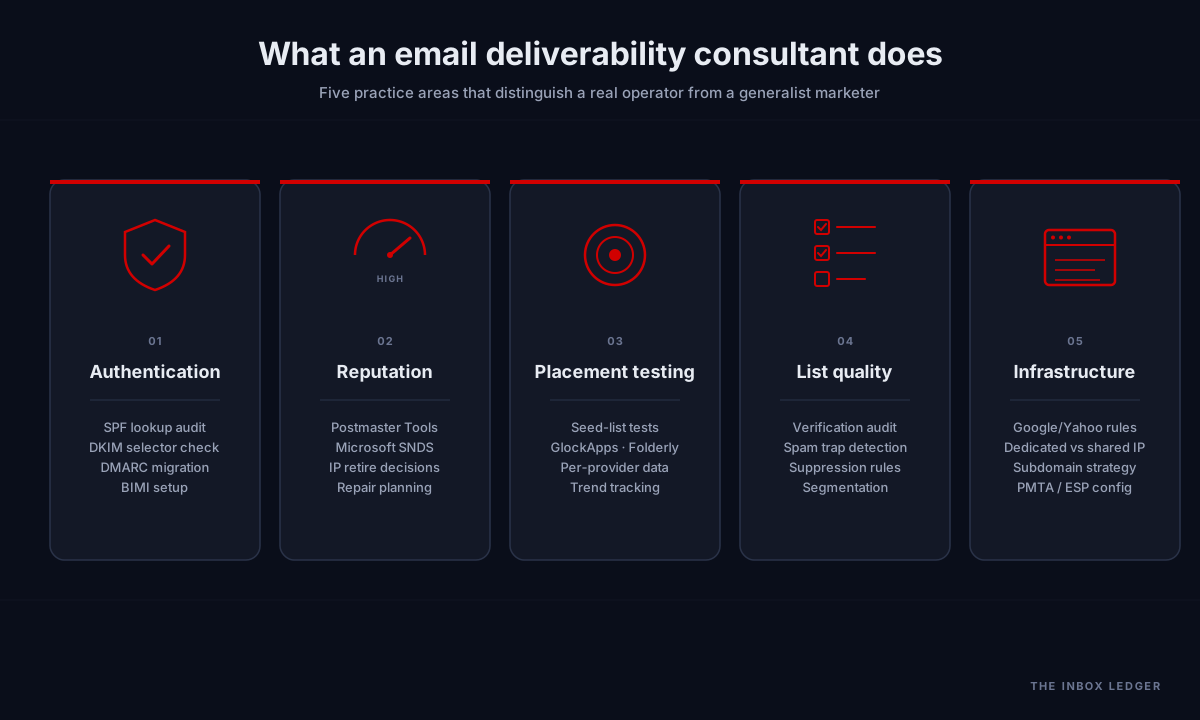
Authentication setup and repair. SPF, DKIM, DMARC, and BIMI. They will check for SPF lookup overflows (RFC 7208 caps these at 10 DNS lookups, and exceeding that limit silently breaks authentication for every message), verify DKIM selectors match what your sending platform actually uses, and design a DMARC migration path. For deeper context on each of these protocols, see our email authentication category.
Sender reputation diagnosis. Reading Google Postmaster Tools and Microsoft SNDS. Identifying whether a Bad/Low reputation flag is recoverable or whether an IP needs to be retired. This is the hardest part of the role because reputation repair takes weeks of disciplined sending, not technical tweaks.
Inbox placement testing. Running seed-list tests through tools like GlockApps or Folderly to measure where mail actually lands across Gmail, Outlook, Yahoo, and corporate filters. Without this data, every other diagnostic is guesswork.
List quality and hygiene work. Verification, suppression, segmentation. Identifying spam traps, role accounts, and recycled addresses that are quietly poisoning sender reputation.
Compliance and infrastructure review. Confirming the sending setup meets Google and Yahoo’s February 2024 sender requirements, expanded by Microsoft in May 2025 and tightened again by Gmail in November 2025. Reviewing dedicated vs shared IP decisions, subdomain strategy, PMTA or ESP configuration.
What a deliverability consultant does not do, despite some agencies marketing it this way: write your email copy, build your campaigns, run your CRM, or guarantee a specific inbox placement number. Anyone promising “100 percent inbox” should be the loudest red flag in your search.
When to hire an email deliverability consultant
Most senders do not need one. Authentication problems can be fixed in hours by anyone willing to read documentation. Routine list hygiene is a verification-tool problem, not a consulting problem. Even moderate reputation issues recover on their own with two months of disciplined sending.
Before you hire email deliverability consultant help, run the basic self-audit first (it filters out 60 to 70 percent of cases). The point where bringing in outside expertise actually makes sense is when one or more of these is true:
The pattern in all of these is the same: the problem is persistent, the cost of being wrong is high, and internal time spent guessing is more expensive than buying expert pattern recognition.
We worked with a Series B HR-tech company that had spent four months trying to fix a deliverability decline internally. Their VP of marketing had read every blog post, tried every tool, and made marginal progress at best. Three weeks of focused work by an outside specialist identified that their marketing subdomain (added eight months earlier) was sharing IP reputation with the parent domain and dragging down both. The fix took an afternoon to plan and a week to implement. The four months of internal effort were not wasted exactly, but they would have been better spent on the work that actually moves their business forward.
The general principle: hire when the cost of continued underperformance exceeds the cost of buying expertise. For most B2B companies sending more than 25,000 messages per month, that crossover comes faster than they realize.
What to look for in an email deliverability consultant
The deliverability space attracts two kinds of people: real operators who have configured PMTA, run DMARC migrations, and debugged Hestia or Postfix in production, and generalist marketers who read a few blog posts and call themselves experts. Filtering between the two is the most important part of hiring.
Real operator background. Ask what they have actually built and run. Specific tools: PMTA, Postfix, Sendgrid, Mailgun, ESP migrations. Specific projects: DMARC migrations from p=none to p=reject, IP warmup at scale, multi-domain authentication audits. A genuine email deliverability expert can name infrastructure they have hands-on experience with. If they cannot, walk away.
Diagnostic discipline. A good email deliverability consultant works through a fixed diagnostic order: authentication first, blacklists second, reputation signals third, inbox placement testing fourth, list audit fifth, content audit sixth, sending pattern seventh. They do not skip steps. They do not jump to “the answer” in the first conversation. The structured approach is the skill.
Tool literacy without tool dependence. They should be fluent in Google Postmaster Tools, Microsoft SNDS, MXToolbox, Mail-Tester, GlockApps or equivalent seed-list testing, and at least one DMARC reporting platform. But they should also be able to read raw email headers and DNS records directly. Anyone who can only operate within a dashboard is not a consultant, they are a tool user.
Reasonable promises. No serious deliverability practitioner guarantees specific inbox placement numbers, because inbox placement depends on factors they cannot control (your content, your audience engagement, mailbox provider algorithm changes). What they should promise: a structured audit, clear documentation of findings, a prioritized remediation plan, and measurable improvements in the specific metrics that are under your control.
Disclosure of methods. A good consultant explains what they are doing and why, in language you can understand. They share their audit framework. They cite RFC 7208, RFC 8058, Google’s bulk sender requirements, and other primary sources. If everything they say sounds like marketing copy, the substance is probably missing.
Red flags to walk away from
The deliverability consulting market has more snake oil than most niches because the technical surface area is wide and clients struggle to evaluate quality. Specific patterns to avoid:
Guaranteed inbox placement. No one can guarantee this. Anyone who does is either lying or about to use techniques that will destroy your sender reputation in 90 days.
“We have a special relationship with Gmail.” Gmail does not have backchannels. Its filtering is algorithmic. There is no whitelist a consultant can put you on.
Pure technical solutions to behavioral problems. If your bounce rate is 7 percent because you are sending to scraped lists, no amount of SPF tweaking fixes it. A consultant whose first instinct is always “let me check your DNS records” without asking about your sending behavior is too narrow.
Heavy upsell into managed services on day one. A good consultant scopes a discrete audit, delivers it, and lets the work speak for itself before proposing ongoing engagement. Pushing managed services before delivering a single insight is a sales-first model, not an expertise-first one.
No references or client examples. Consulting is a referral business. A practitioner with three years of experience should be able to name 5-10 client situations they have worked through (anonymized is fine).
What email deliverability consulting actually costs in 2026
Pricing varies by engagement model. The numbers below reflect what we see in the market in 2026.
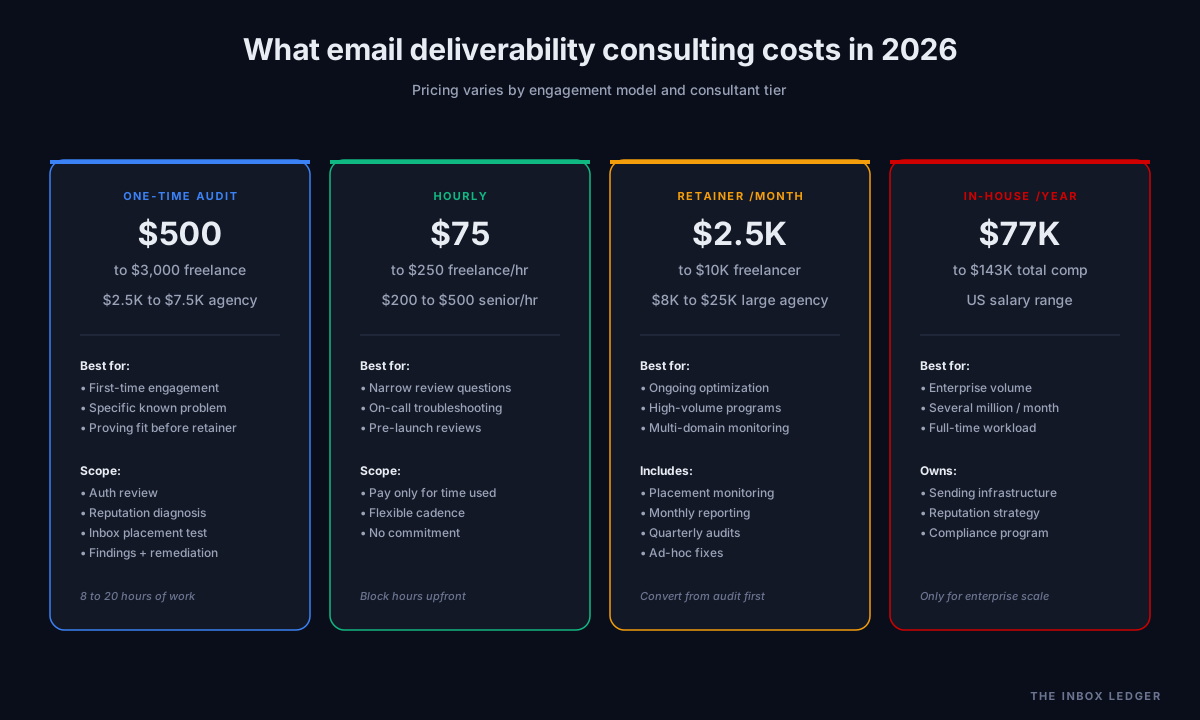
One-time audit (project pricing). A focused deliverability audit (authentication review, reputation diagnosis, inbox placement test, prioritized findings report) runs $500 to $3,000 for a freelancer and $2,500 to $7,500 for a small agency. The audit itself typically takes 8 to 20 hours of consultant time. Lower-end engagements skip the seed-list testing (which adds tool cost) and focus on authentication and configuration review.
Hourly consulting. Freelance email deliverability consultants bill $75 to $250 per hour. Senior specialists with deep PMTA or enterprise experience bill $200 to $500 per hour. Hourly is the right model for narrow questions (“review my DMARC strategy before we go to enforcement”) or for ongoing optional access (“I want to be able to call someone when something breaks”).
Monthly retainer. $2,500 to $10,000 per month for a freelancer or small consultancy, depending on scope and sending volume. Mid-sized agencies run $4,000 to $10,000. Large agencies with enterprise-grade infrastructure and dedicated account teams run $8,000 to $25,000. Retainers usually include: ongoing inbox placement monitoring, monthly reporting, quarterly authentication audits, and ad-hoc troubleshooting when issues arise.
In-house hire. A full-time deliverability specialist costs $77,000 to $143,000 per year in total compensation in the US, depending on seniority. This is only worth it for companies sending several million messages per month, where the role is full-time work.
For most B2B companies, the right entry point is a one-time audit for $1,500 to $5,000, with the option to convert to a monthly retainer if ongoing work is justified. Start small, prove value, expand. Avoid agencies that insist on a 12-month retainer commitment as the only engagement option.
The audit framework we use
Every email deliverability consultant should have a documented audit framework. Ours has seven steps, run in fixed order because earlier issues mask later ones. The deeper version of this is in our email deliverability pillar guide; the short version:
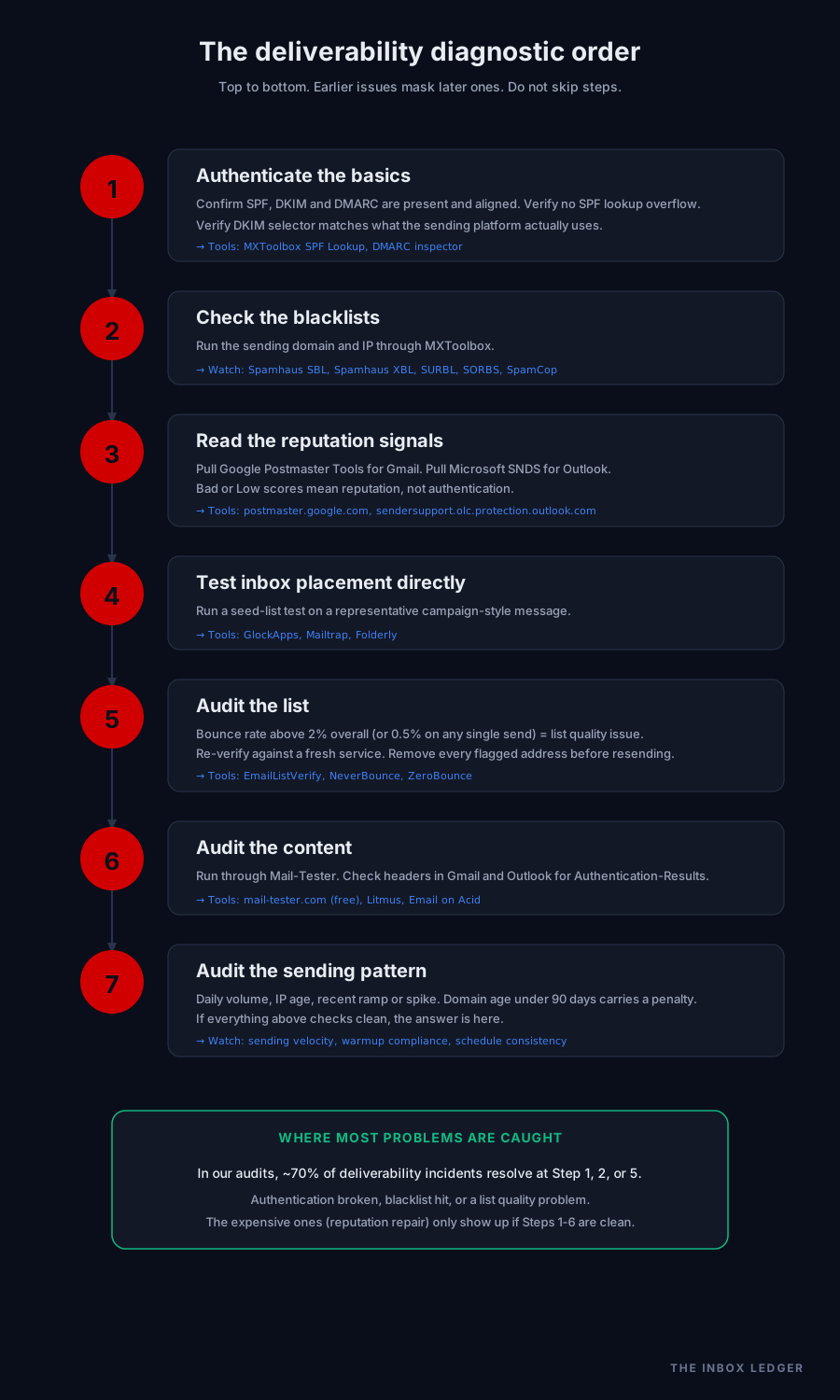
- Authentication review. SPF, DKIM, DMARC. Verify all present, aligned, and not throwing PermError.
- Blacklist check. Spamhaus SBL/XBL, SURBL, SORBS, SpamCop. Delisting takes priority over everything downstream if listed.
- Reputation signals. Google Postmaster Tools, Microsoft SNDS. Bad or Low scores point to behavioral problems, not technical ones.
- Inbox placement testing. Seed-list test through GlockApps, Mailtrap, or Folderly. Real placement data across providers.
- List audit. Bounce rate analysis, verification pass against a fresh service, identification of role accounts and high-risk addresses.
- Content audit. Mail-Tester score, header analysis, HTML validation, image-to-text ratio review.
- Sending pattern review. Daily volume, IP age, warmup status, sending velocity consistency.
A consultant who works in this order is doing the work. A consultant who jumps to step 4 or 5 first is taking shortcuts you will pay for later.
What to expect from an audit deliverable
A finished email deliverability audit should produce four things:
A findings report. Plain-language summary of what is working, what is broken, and what is at risk. Specific configuration details (your SPF lookup count, your DMARC policy state, your Postmaster reputation scores). Not generic advice.
A prioritized remediation plan. Each finding ranked by severity (critical, high, medium, low) and effort (hours to days). The critical findings should be fixable inside the first week.
Configuration documentation. Exact DNS records you should publish, exact ESP settings you should change, exact infrastructure decisions you should make. Implementable by your team without further back-and-forth.
A retest plan. When to re-run the seed-list test, when to check Postmaster again, what metrics to watch over the next 90 days. Without this, you have no way to measure whether the work landed.
Audits that produce only a list of “best practices” without specifics are not real audits. They are templated reports.
When you should not hire a consultant
A few situations where bringing in an email deliverability consultant is the wrong move:
You have not tried basic diagnostics yourself. If you have not pulled your Google Postmaster Tools data, run your domain through MXToolbox, or sent a test email through Mail-Tester, you have not done the work that justifies expertise spend. Most “deliverability problems” reported by new senders are actually authentication misconfigurations visible in a 30-minute self-audit.
Your problem is a copy or targeting problem in disguise. If your reply rate is 0.5 percent on a list of 50,000 strangers with generic templated outreach, deliverability is not your problem. The campaign is. A consultant will tell you this, but charging $3,000 to be told your copy is generic is an expensive lesson.
You are sending fewer than 5,000 emails per month. Below this volume, almost any deliverability issue is solvable with a free verification pass and the basic authentication setup. The economics do not justify external consulting.
You want a guarantee. No reputable email deliverability consultant will guarantee specific outcomes. Anyone who does is either inexperienced or planning to use shortcuts that damage you in the medium term.
How to actually start
If you have decided an email deliverability consultant is the right move, the practical path:
-
Run a 30-minute self-audit first. Pull Google Postmaster Tools data, check your DMARC record, run a Mail-Tester. This makes the consulting conversation much more efficient because you arrive with data.
-
Get 2-3 quotes for a one-time audit. Scope: authentication review, reputation diagnosis, inbox placement test, prioritized findings report. Budget $1,500 to $5,000.
-
Compare on substance, not pitch. Ask each candidate to walk through their audit framework. Ask what they would check first if you described a specific problem. Their answers will tell you whether they actually do the work or just talk about it.
-
Start with the audit only. Do not commit to a retainer before seeing how they work. A consultant who refuses to do a one-time audit and insists on a retainer-only model is selling commitment, not expertise.
-
Convert to retainer only if needed. Most companies do not need ongoing deliverability consulting once the audit findings are implemented. Quarterly check-ins are usually enough. Continuous retainers are only worth it for high-volume senders (over 500,000 per month) where new issues surface frequently.
Frequently asked questions
What does an email deliverability consultant do?
How much does an email deliverability consultant cost?
When should I hire an email deliverability consultant?
What is the difference between a deliverability consultant and a deliverability specialist?
Can a deliverability consultant guarantee inbox placement?
How long does an email deliverability audit take?
Should I hire a freelance email deliverability consultant or an agency?
The bottom line
Hiring an email deliverability consultant is not a substitute for understanding your own sending behavior. It is a way to compress months of internal trial-and-error into a few weeks of expert pattern matching. For most B2B companies sending 25,000 or more messages per month with persistent inbox placement issues, a one-time audit in the $1,500 to $5,000 range is the highest-leverage spend they can make. If you want us to run that audit for your setup, get in touch. Otherwise, the deliverability pillar guide walks through the full diagnostic order you can run yourself, and the deliverability category covers individual problem areas in depth.
Subscribe to the weekly briefing for cold email deliverability deep-dives, sender reputation case studies, and tool comparison reports.
More on Deliverability
Email blacklist removal 2026: the operator playbook
Email blacklist removal in 2026: diagnose the root cause first, identify the tier, delist in the right order, prevent re-listing. The full playbook.
Email deliverability monitoring vs warmup: 2026 guide
Email deliverability monitoring vs warmup in 2026: what each does, when you need both, and why monitoring is non-negotiable post-enforcement.
Spam complaint rate 2026: the 0.3% operator playbook
Spam complaint rate in 2026: the 0.3% threshold explained, why ESP dashboards underreport, the five drivers of complaints, and the recovery playbook.