Cold email agency: how to choose one that books meetings
Cold email agency hiring guide for 2026: what they actually do, how to evaluate them, the red flags, the questions to ask, and when to hire vs DIY.
A cold email agency takes the operational grind of outbound off your team’s plate: domains, inboxes, authentication, list building, copywriting, sequence management, reply triage, and reporting. The right one books meetings on your calendar consistently. The wrong one burns $15,000 to $50,000 of budget across 90 days, produces vanity reports full of open rates, and damages your domain reputation in the process. The pricing tier between those two outcomes is often identical.
This guide is the cold email agency evaluation framework we use when clients ask whether to hire one, which one to hire, and how to structure the engagement. It covers what cold email agency services actually include, how the three pricing models work, the 7 criteria that separate the agencies producing pipeline from the ones producing decks, the red flags that show up in the sales conversation, and the realistic pricing math for 2026.
What a cold email agency actually does
A full-service cold email agency engagement typically covers four operational areas:
Infrastructure and deliverability. Buying secondary sending domains, provisioning inboxes (typically Google Workspace or Microsoft 365), configuring SPF, DKIM, DMARC, and RFC 8058 one-click unsubscribe. Warming up the inboxes through 4 to 6 weeks of structured ramp before any campaign volume. Monitoring placement and reputation throughout.
List building and ICP targeting. Defining the ideal customer profile, sourcing prospects from data providers and direct research, verifying email addresses to keep bounce rates under 2 percent, and continuously refining the targeting based on reply patterns.
Copy and sequence development. Writing the initial outreach message and the 4 to 6 follow-up touches, A/B testing subject lines and openers, iterating on the messaging based on reply data, and adapting the copy to different ICP segments.
Campaign management and reply handling. Running the sending platform (Smartlead, Instantly, or equivalent), managing volume across mailboxes, triaging incoming replies, qualifying positive responses, and either booking meetings directly or handing qualified responses to your sales team. The exact handoff point varies by agency.
The deliverable that matters is qualified meetings booked. Not emails sent. Not open rates. Not “impressions.” If a cold email marketing agency leads with anything other than meetings as the primary metric, that is the first signal to look elsewhere.
Cold email agency vs the alternatives
Before hiring an agency, the alternatives worth comparing:
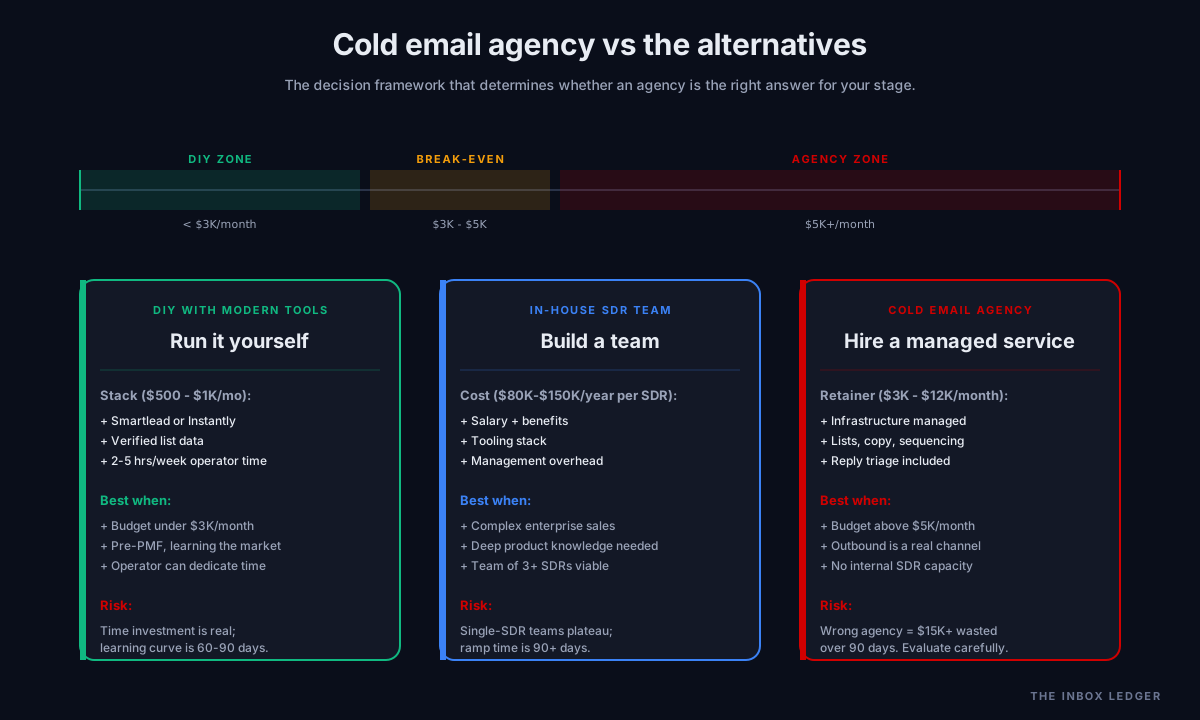
Cold email agency vs in-house team
In-house cold email costs $80,000 to $150,000 per year fully loaded (SDR salary, tooling, infrastructure) for a single person who needs to scale to a team of 3 to 5 before performance plateaus. A mid-market cold email agency at $4,000 to $8,000 per month covers infrastructure, list building, copy, and management for less than the all-in cost of one in-house SDR. The cost math typically favors the agency until the in-house team can keep at least 3 SDRs productive.
The trade-off is control. In-house teams can pivot messaging in a day; agencies typically batch changes into the next campaign cycle. In-house teams understand your product deeply; agencies require a strong onboarding to get there. For complex enterprise sales, in-house tends to win. For high-velocity SMB and mid-market outbound, agencies often win.
Cold email agency vs deliverability consultant
These are different services for different problems. A deliverability consultant audits and fixes specific deliverability issues, typically as a project engagement of $5,000 to $25,000 over 30 to 90 days. They do not run your campaigns; they fix the infrastructure your campaigns sit on. A cold email agency runs the entire program end to end on an ongoing retainer.
Hire a consultant when something is broken (placement collapsed, complaint rate spiked, domain blocklisted). Hire an agency when you want the whole outbound function managed externally.
Cold email agency vs freelancer
Freelance cold email operators run programs solo, typically for $1,500 to $4,000 per month. The quality range is wide: some are excellent operators who chose not to scale a team; some are entry-level practitioners who undercharge because they have not yet learned what they are missing. Freelancers work well for single-ICP campaigns at modest volume. They struggle with multi-ICP programs, multi-language outbound, or any program that needs more than one person working on it at a time.
Cold email agency vs DIY with modern tools
If your monthly outbound budget is under $3,000, DIY is typically the better answer. A modern stack of Smartlead or Instantly ($100 to $300 per month), verified data through a tool like EmailListVerify ($30 per 100,000 verifications), and a thoughtful operator running 2 to 5 hours per week produces better results than most $1,500 per month agencies. The break-even point is usually $3,000 to $5,000 per month in agency spend; below that, DIY wins; above that, a good agency starts to pay for itself.
The three cold email agency pricing models
Cold email agency services in 2026 generally use one of three pricing structures. Each has different incentive alignment:
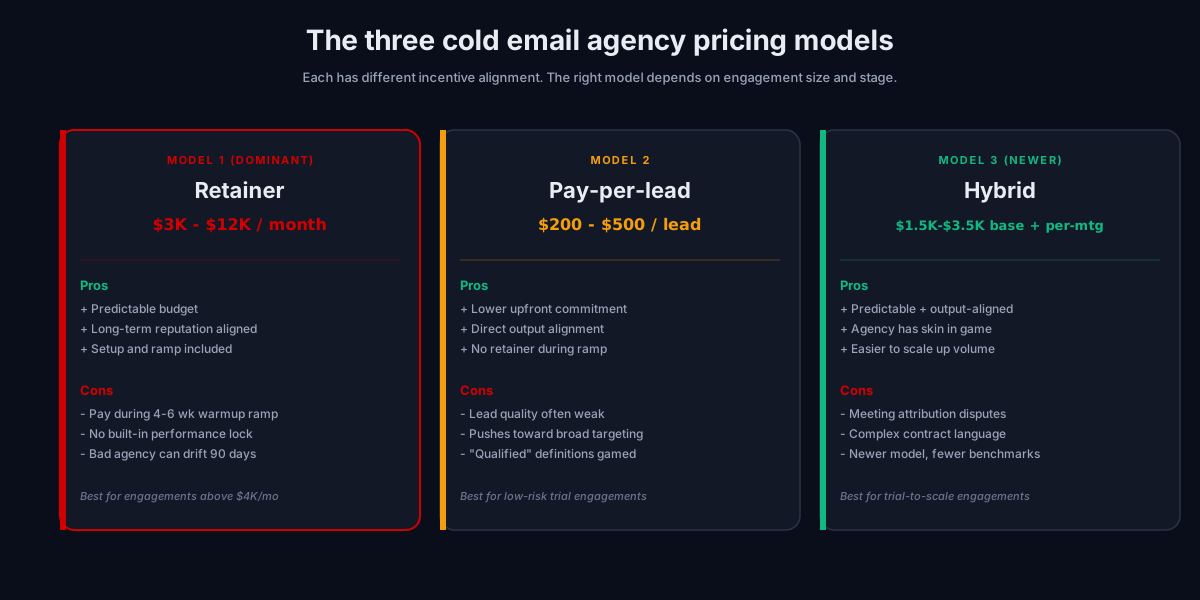
Retainer model ($3,000 to $12,000 per month)
The dominant model. Fixed monthly fee covers a defined scope: infrastructure, list building, copy, campaign management, reporting. You pay regardless of results within the contract period.
Pros: Predictable budget. Aligns the agency on long-term reputation building rather than short-term lead chasing. Includes setup and ramp work that pay-per-lead models do not.
Cons: You pay during the 4 to 6 week warmup ramp when no real campaigns are running yet. Performance lock-in is on the agency to deliver, not built into the pricing. A bad agency can collect retainer for 90 days with little to show.
Pay-per-lead model ($200 to $500 per qualified lead)
Agency charges only for leads that meet pre-defined qualification criteria. Definition of “qualified” varies and is the source of most disputes.
Pros: Lower upfront commitment. Direct alignment on output rather than effort.
Cons: Quality control is often weak. Agencies optimizing for lead volume relax qualification standards. The economics push agencies toward broad-targeting campaigns rather than precise signal-based outreach. Lead definitions can be gamed.
Hybrid model (base fee plus per-meeting commission)
Smaller base retainer ($1,500 to $3,500 per month) plus $150 to $500 per booked meeting that the agency sources. Newer model that has grown in 2025-2026.
Pros: Combines budget predictability with output alignment. Agency has skin in the game on meetings booked, not just effort.
Cons: Requires very clear definitions of what counts as an agency-sourced meeting vs an inbound or referral that happened to come during the engagement. Disputes over meeting attribution are common.
For most B2B cold email agency engagements above $4,000 per month, the retainer model with clearly defined output expectations works best. For trial engagements or smaller budgets, hybrid models reduce the downside risk.
The 7 criteria for choosing the best cold email agency
Across the engagements we audit, seven decision factors separate cold email agencies that produce pipeline from agencies that produce activity. Ranked by impact:
1. Domain isolation and infrastructure setup
The agency must set up dedicated sending domains separate from your primary brand domain. Sending cold outreach from yourcompany.com instead of outreach-yourcompany.com damages your account team, support, and transactional reputation simultaneously. This is non-negotiable in 2026. Any agency proposing to send from your primary domain is disqualified before the rest of the evaluation begins.
2. Meetings as the primary KPI
The monthly report leads with meetings booked, replies received, and pipeline created. Not open rates. Not emails sent. Tracking pixels for open rates require HTML email formatting, which actively hurts deliverability for cold outreach. An agency that still leads with open rates either does not understand current best practices or is selling vanity metrics on purpose.
3. Transparent reporting on deliverability metrics
The agency surfaces bounce rate, spam complaint rate, and inbox placement on every campaign. Bounce rate should stay under 2 percent on any single send. Spam complaint rate operating ceiling is 0.1 percent (hard ceiling 0.3 percent before Gmail and Yahoo trigger enforcement per Google’s 2024 sender requirements). Microsoft’s May 2025 expansion of these requirements made the same enforcement effective for Outlook and Hotmail recipients. Authentication compliance per RFC 8058 one-click unsubscribe is now mandatory for bulk sending. If the agency does not report these metrics, they are not measuring what determines whether the program succeeds.
4. ICP refinement loop
Good agencies refine the ICP and targeting based on reply patterns from the first 2 to 4 weeks of sending. A campaign sent to 5,000 prospects with a 1 percent reply rate produces 50 replies, of which maybe 30 are negative or out of office. The 20 positive replies contain signal about who actually engages. The agency should be feeding that signal back into the targeting; if they do not, you will see the same reply rate quarter after quarter.
5. Contract terms and exit clauses
Industry standard is month-to-month after an initial 60 to 90 day setup period. Agencies pushing 6-month or 12-month minimums without performance clauses are a red flag. Confidence in the work shows up as confidence in the terms. The exception is when the agency is fronting significant setup cost (multiple domains, dozens of inboxes); a 90-day minimum to recoup that work is reasonable.
6. Specialization match
Some agencies specialize in SaaS. Some specialize in agencies. Some in financial services. Some in healthcare. Some in cold outreach to Japan or DACH specifically. A B2B cold email agency that has run hundreds of campaigns in your vertical brings pattern recognition that a generalist agency does not. Always ask what percentage of their current book is in your space.
7. Communication cadence and access
Weekly status calls. Direct Slack or email access to the campaign manager. Visibility into the actual campaigns running, not just a dashboard summary. Agencies that route all communication through account managers and produce only PDF reports are typically optimizing for their internal economics, not your visibility into the work.
Cold email agency red flags
The patterns we see most often in agencies that disappoint clients:
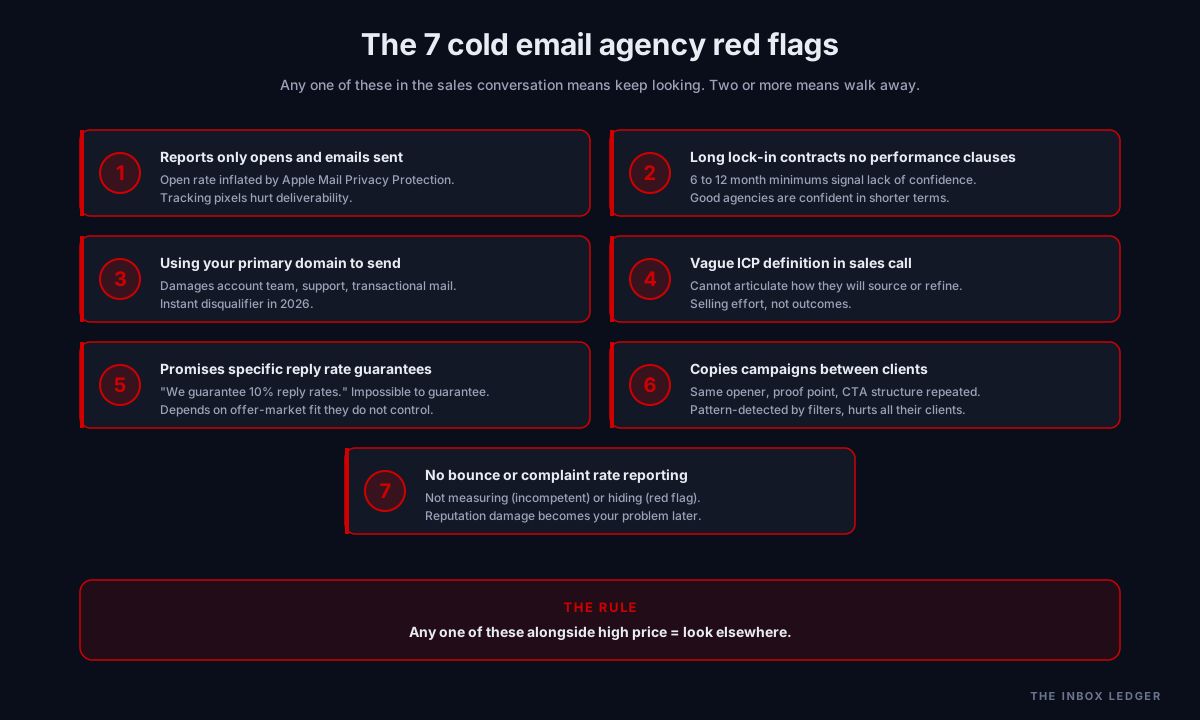
1. Reporting only on open rate and emails sent
The two metrics that mean the least and are easiest to inflate. Apple Mail Privacy Protection automatically opens emails on behalf of users, inflating open rates by 10 to 15 percent on most lists. An agency optimizing for open rate is optimizing for a metric divorced from revenue. The corollary: if HTML formatting is being used to enable open-tracking pixels, deliverability is being actively compromised for the sake of the metric.
2. Long lock-in contracts without performance clauses
6 to 12 month minimums with no defined performance expectations or out clauses. A confident agency commits to month-to-month or 90-day terms because they expect to keep the client through performance, not through contract obligation.
3. Using your primary domain for sending
Already covered above. Disqualifying.
4. Vague ICP definition in the sales conversation
If the agency cannot articulate how they will define your ICP, how they will source prospects matching it, and how they will refine the definition over time, they do not have a real process. They are selling effort, not outcomes.
5. Promising specific reply rate guarantees
“We guarantee 10 percent reply rates.” No agency can guarantee reply rates because reply rate depends on offer-market fit (which the agency does not control), list quality (which they partially control), and copy quality (which they fully control). Guarantees in this space are either marketing language that means nothing in the contract, or they are setting up the agency to game the metric definition to look like they hit it.
6. Copying campaigns between clients
The same opener, the same proof point, the same CTA structure used across multiple clients. Mailbox providers detect repeated content patterns across millions of sends and apply spam treatment regardless of authentication. An agency that templates aggressively is degrading the deliverability of every client they run.
7. No bounce or complaint rate reporting
If the monthly report does not include bounce rate and spam complaint rate, the agency either is not measuring them (incompetence) or is hiding them (red flag). Both versions end the same way: reputation damage that becomes your problem when you take the program in-house.
Realistic pricing math for 2026
What different cold email agency price points actually buy:
$500 to $1,500 per month. Typically freelance operators, not full agencies. Limited list building (often relying on shared lists). One or two ICPs. Minimal A/B testing. Suitable for single-channel campaigns at low volume. Better than nothing for early-stage companies; worse than DIY with modern tools for most operators.
$1,500 to $3,000 per month. Entry-tier agencies. Basic infrastructure setup. Standardized copy patterns. Limited reply management. Usually does not include reply triage beyond auto-classification. The break-even point against DIY is right here; below this, DIY wins; above this, agencies start to add value.
$3,000 to $6,000 per month. Mid-tier agencies. Custom ICP research per campaign. Real A/B testing. Multi-step sequences. Active reply management with human qualification. Weekly reporting calls. This is where most B2B cold email agency engagements that actually work sit.
$6,000 to $12,000 per month. Full-service agencies. Multiple ICPs run in parallel. Multi-channel touches (email + LinkedIn + sometimes phone). Senior-level account management. Higher-volume sending across dozens of mailboxes. Industry specialization. Best fit for established companies running outbound as a primary growth channel.
$12,000+ per month. Enterprise-tier or vertical specialist agencies. Custom integration with your CRM. Dedicated team assigned to the account. Often includes adjacent services like ABM strategy, sales enablement content, or RevOps consulting. Decisions at this tier are made by VP-level buyers and rarely on the basis of cold email mechanics alone.
For the realistic conversion math: an agency producing a 3 percent reply rate at 5,000 emails per month produces 150 replies, of which roughly 40 to 60 are positive responses worth pursuing, leading to 10 to 20 booked meetings. At $5,000 per month agency cost plus ~$500 in tooling, that is roughly $275 to $550 per booked meeting before factoring in conversion to opportunity and close.
How to choose a cold email agency: questions to ask before signing
The diagnostic questions that separate the agency you want to hire from the one that just sounds like it:
- What sending domains will you use, and how do they relate to my primary domain? Correct answer: dedicated subdomains, never the primary domain.
- What is your current bounce rate and spam complaint rate across active campaigns? Correct answers: under 2 percent and under 0.1 percent. Vague answers are a red flag.
- What does your monthly report actually include? Should lead with meetings booked, then replies received, then pipeline created. If they lead with opens or sends, look elsewhere.
- What percentage of your current clients are in my industry? Specialization match matters; a good answer is 20 percent or more in your specific vertical.
- What are your contract terms and exit clauses? Month-to-month after a 60 to 90 day setup is the standard you are looking for.
- Can I see a sample sequence (with client names redacted) from a current campaign? Real agencies have nothing to hide here. Resistance is a red flag.
- How do you refine the ICP and copy based on reply data? They should be able to articulate a specific feedback loop, not generalities about “iteration.”
- Who specifically will be running my account day to day? You want to talk to that person before signing, not just the sales lead.
- What is your reply management scope? Specifically: do they qualify replies and book meetings on your calendar, or hand off positive replies to your team? Both models work; the agency should be clear about which one.
- Can you connect me with two current clients in my industry as references? Reference checks are non-negotiable above $5,000 per month.
When NOT to hire a cold email agency
Three scenarios where DIY or a different solution beats hiring an agency:
Pre-product-market fit. If you do not know yet which segment your product resonates with, an agency optimizing within a pre-defined ICP will not help you find PMF. You need to be running the conversations yourself to learn what the market is telling you.
Very small TAM. If your total addressable market is under 2,000 accounts, you do not need an agency running automated outbound; you need a senior person doing personalized 1-to-1 outreach. The agency model breaks below this scale.
Compliance-restricted industries. Healthcare with PHI, financial services with specific regulatory language requirements, government sales. These verticals have outreach constraints that most cold email agencies are not equipped to handle. A specialist agency that knows your specific compliance landscape is fine; a generalist agency will create more problems than they solve.
For the broader operational framework that informs whether outbound is the right channel at all, see our cold email outreach playbook. For the deliverability foundations that any agency engagement sits on, see the email deliverability pillar guide and the 47-point cold email deliverability checklist.
Frequently asked questions
What does a cold email agency actually do?
How much does a cold email agency cost in 2026?
How do I choose a cold email agency?
Should I hire a cold email agency or run it in-house?
What are the red flags when evaluating a cold email agency?
What is a realistic reply rate from a cold email agency?
How long until a cold email agency produces results?
The bottom line on hiring a cold email agency
A cold email agency is a force multiplier when the fundamentals are right and a budget incinerator when they are wrong. The difference shows up in the first sales conversation: agencies that lead with meetings, infrastructure, and deliverability metrics are operating on the 2026 playbook. Agencies that lead with open rates, “engagements,” and case-study screenshots are selling 2022’s playbook on 2026 inboxes.
For the broader framework on whether outbound is the right channel at all, the cold email outreach playbook covers the strategic context. For the operational foundations that any cold email agency engagement sits on, see the SMTP relay guide and the email warmup tools guide. For when the problem is a specific issue rather than wholesale program management, the email deliverability consultant guide covers the project-based alternative.
Subscribe to the weekly briefing for cold email agency teardowns, vendor comparison reports, and deliverability deep-dives.
More on Cold Email
Best cold email software 2026: 8 platforms by use case
Best cold email software 2026: the 8 platforms that actually work, categorized by operator profile, with pricing, deliverability, and use case fit.
Cold email follow up: the 2026 sequence that gets replies
How to structure a cold email follow up sequence in 2026: number of touches, timing, what each message should say, and the deliverability rules.
Cold email outreach in 2026: what actually works now
Cold email outreach in 2026: the strategy, infrastructure, copy, and cadence that book meetings. What changed, what still works, what to stop doing.