Best email deliverability services for B2B in 2026
The best email deliverability services in 2026, ranked by what actually moves inbox placement. Audits, monitoring, repair, and when to skip them.
Picking the best email deliverability services in 2026 looks deceptively simple from the outside: read a few “top 10” lists, sign up for the one with the cleanest dashboard, watch your open rates climb. That is not what happens. On the audits we run, roughly 70 percent of B2B teams paying for the best email deliverability services on the market are paying for the wrong category of tool entirely. They bought monitoring when they needed repair, or repair when they needed an audit, or an audit when their problem was a CRM hygiene issue that no vendor can fix.
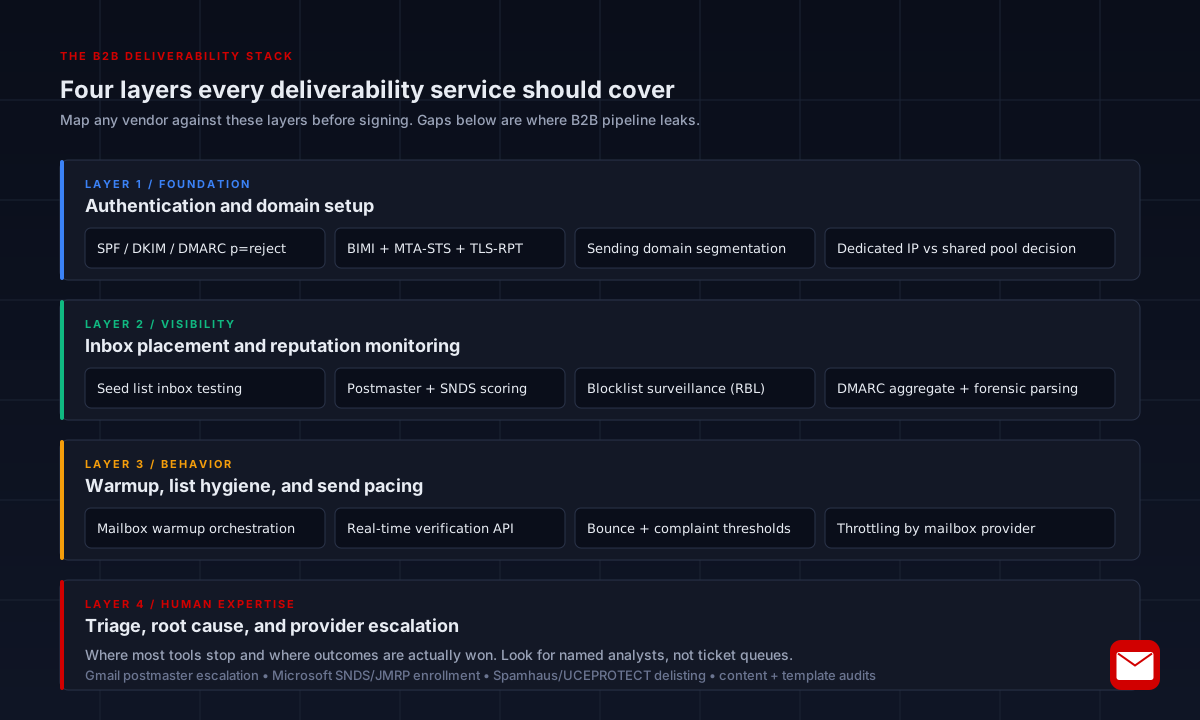
The category has also gotten genuinely crowded. Since Google and Yahoo enforced bulk sender requirements in February 2024 and Microsoft expanded equivalent rules in May 2025, every vendor that touches email has rebranded as a “deliverability service.” That is marketing, not architecture. The actual category splits into four functions, and the best email deliverability services are the ones honest about which function they perform.
This guide walks through that split, names the tools we see working in 2026, and tells you when to skip the vendor entirely and just fix the underlying problem. The goal is to make sure the money you spend on an email deliverability service actually moves inbox placement, not just dashboard metrics. We will compare the best email deliverability services across testing, monitoring, repair, and audit so you can match spend to actual need.
What an email deliverability service actually is
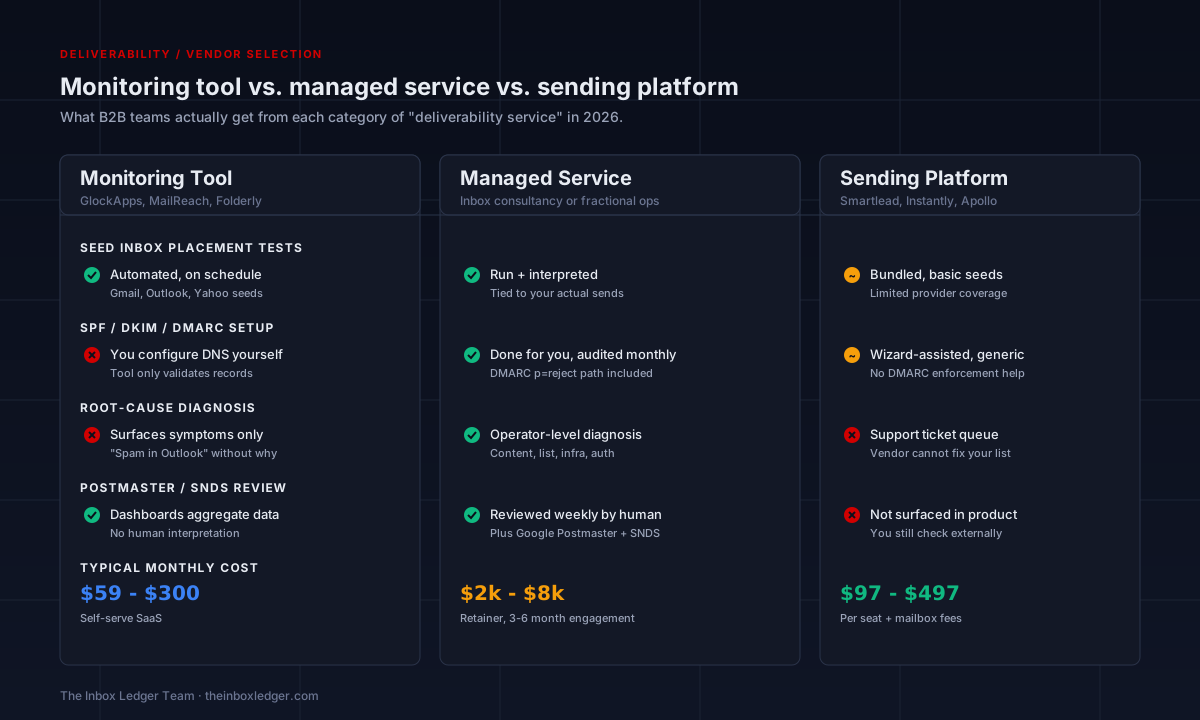
The phrase “email deliverability service” gets used for at least four different products that solve different problems. The fastest way to waste money is to buy one when you needed another. Here is the honest taxonomy that frames how the best email deliverability services position themselves in 2026.
Inbox placement testing
These are seedlist tools. You send a test campaign to a panel of mailboxes (Gmail, Outlook, Yahoo, corporate Microsoft 365) and the service reports where each one landed: inbox, promotions, spam, or missing entirely. Good for spot checks before a launch. Useless as a long-term diagnostic, because seedlist results do not predict real recipient placement (Gmail’s content classification is personalized). Inbox placement testing is the most commonly oversold function in the best email deliverability services market.
Deliverability monitoring
These tools watch your sending posture continuously: DMARC aggregate reports, blacklist status, authentication failures, postmaster data trends. They alert when something breaks. Critical infrastructure if you send at any scale. Worthless if nobody on your team will read the alerts. The serious deliverability monitoring tools share one trait: they push alerts to a channel a human will actually see.
Deliverability repair (warmup, reputation rebuild)
These are warmup networks and reputation services. They generate engaged-looking traffic to your domain or mailbox to rebuild a damaged sender reputation. Genuinely useful when you have a measurable reputation problem. A waste of money (and increasingly risky) when used preventatively on healthy senders. We covered the working set in email warmup tools in 2026.
Full deliverability audit / consulting
This is a human (or human-plus-tooling) engagement that diagnoses the entire stack: domain architecture, authentication, list hygiene, content patterns, sending behavior, infrastructure choice. Output of a real email deliverability audit is a remediation plan, not a dashboard. We wrote the long version at when to hire an email deliverability consultant, and a good deliverability consultant will tell you which of the other three categories you can skip.
The teams we work with that have the cleanest inbox placement use exactly two services: one monitor and one audit (annual). Everything else is noise. That is the honest baseline behind every “best email deliverability services” list worth reading.
The best email deliverability services in 2026, by category
This is the working set. We have used or audited all of them. The ranking inside each category is by fit for B2B outbound and lifecycle teams, not by marketing spend. Treat this as the operator’s cut of the best email deliverability services rather than a vendor leaderboard.
Best inbox placement testing tools
GlockApps is the long-running standard for seedlist testing and one of the inbox placement testing tools we still recommend in 2026. Their panel covers all the major consumer providers plus a reasonable spread of Microsoft 365 tenants. The DMARC and spam-filter analyzer that ships alongside the seed tests is useful. Pricing starts low and scales with test volume.
Test inbox placement with GlockAppsMailtrap is primarily a transactional email testing platform (it intercepts test sends so they never reach real users), but their deliverability suite includes inbox placement, blacklist monitoring, and an SMTP testing sandbox. Best fit if your team also ships product email and you want one tool covering both functions.
Sandbox and inbox placement testing with MailtrapA note on seedlist accuracy in 2026: Gmail’s filtering has gotten so personalized that a seed inbox result tells you very little about how a specific corporate recipient will see your mail. Treat inbox placement testing as a pre-flight check, not as a diagnostic. The signal you actually need lives in Google Postmaster Tools and Microsoft SNDS, both free.
Best deliverability monitoring tools
Google Postmaster Tools (free, official). If you send any meaningful volume to Gmail and you are not watching domain reputation, spam rate, and authentication trends here daily, no paid tool will save you. This is the source of truth Gmail itself uses, and it is the data point Google’s own bulk sender guidelines reference when they talk about the 0.3 percent spam complaint threshold.
Microsoft SNDS (free, official). The Microsoft equivalent. Less granular than Postmaster, but it is the only direct read on how Outlook.com and Microsoft 365 see your IPs.
DMARC aggregate report tooling is the third leg of the deliverability monitoring tools stack. Raw DMARC reports are XML and unreadable at scale. The serious options in 2026 are Valimail, EasyDMARC, and dmarcian. All three do roughly the same thing well. EasyDMARC tends to be the cheapest fit for B2B teams under 500 employees. If you need help interpreting the DMARC RFC, one of these tools is non-negotiable.
Best deliverability repair services
Folderly is the most mature deliverability repair service we see in 2026, and it consistently shows up in our own shortlist of best email deliverability services for repair. They combine an automated warmup network with manual reputation work, content scoring, and direct mailbox provider remediation when something goes wrong at scale. Pricing reflects the fact that there is a human team in the loop, which is the entire point.
Pure warmup networks (Warmup Inbox, MailWarm, lemwarm, TrulyInbox) belong here too, but they are tools, not services. They run unattended. They work well for healthy domains in a maintenance posture and poorly as a fix for an active reputation problem. The full breakdown lives in the email warmup tools guide.
Best full deliverability audit
This is the category where “service” actually means what it sounds like: a human looks at your sending program and tells you what is broken. A proper email deliverability audit covers domain architecture, authentication, list hygiene, content, and infrastructure in one pass. There are a handful of independent operators worth hiring (we wrote the criteria at email deliverability consultant: when to hire one) and a few firms that do this credibly. A good deliverability consultant will usually save you more in tool spend than the audit costs.
The framework: which deliverability service do you actually need
Run this decision in order. Stop at the first “yes.” This is how we narrow the best email deliverability services down to the one or two that fit a specific team.
1. Are you about to launch a new sending program or a new domain? You need inbox placement testing (GlockApps or Mailtrap) plus a warmup tool. You do not need a repair service yet.
2. Are your Google Postmaster Tools showing domain reputation “Low” or “Bad,” or complaint rate above 0.3 percent? You need a repair service (Folderly) and a list hygiene tool. Skip everything else until reputation is back to “High” or “Medium.”
3. Do you send transactional and marketing/outbound from the same domain or subdomain? You do not need a deliverability service. You need a domain architecture fix, which is an audit problem. See the discussion in email deliverability: the 2026 pillar guide.
4. Are reply rates dropping but Postmaster and SNDS look clean? This is almost always a content or targeting problem, not an inbox-placement problem. Audit first, tool second.
5. Do you have authentication errors in DMARC reports you have not investigated? You need a DMARC monitoring tool (EasyDMARC or Valimail). The relevant RFCs (SPF, DKIM, DMARC) explain the failure modes, but the report parsing is what you are paying for.
6. Are bounce rates above 2 percent on cold outbound? Skip the deliverability service entirely. You have a list hygiene problem.
Common mistakes when buying an email deliverability service
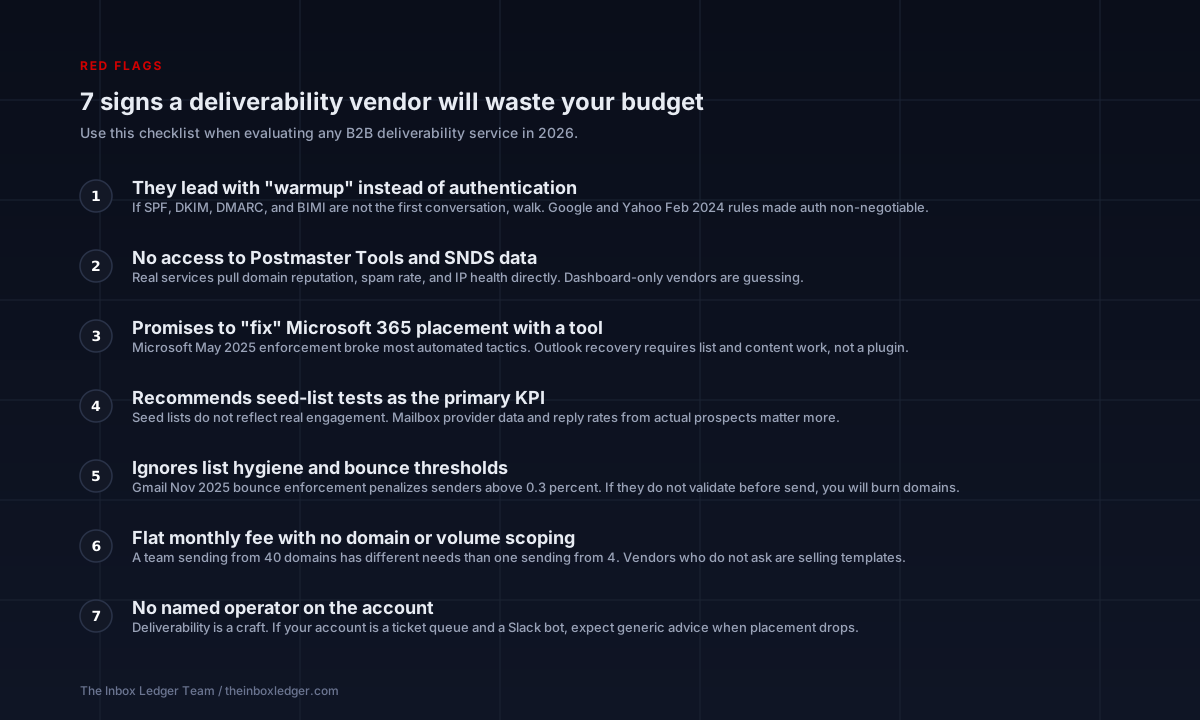
These are the patterns we see most often on intake calls, and they show up across every “best email deliverability services” list that ranks by feature count instead of fit.
Buying monitoring before fixing authentication. A monitoring tool will faithfully report that your SPF, DKIM, and DMARC are broken. It will not fix them. If you know authentication is the issue, fix it first (SPF/DKIM/DMARC setup walks through the configuration), then turn on monitoring.
Buying repair before fixing the list. Warmup and reputation services rebuild your sender reputation by generating engaged-looking traffic. If your real traffic is still going to dead mailboxes and spam traps, you are pushing water uphill. List hygiene first, then repair. We covered the hygiene stack in email hygiene in 2026.
Buying a generalist email deliverability service for a cold-outbound problem. Many of the well-known deliverability vendors are built for marketing and lifecycle teams (newsletters, product updates, transactional). Cold outbound has different failure modes and different remediation. Specialist tools (the cold email infrastructure stack) and operators who actually run outbound programs are the right fit. See cold email outreach in 2026.
Confusing “blacklist removal” with “deliverability fix.” Most public blacklists barely affect Gmail or Microsoft 365 placement in 2026. A service whose primary pitch is “we get you off blacklists” is solving a 2015 problem. The blacklists that matter today (Spamhaus, primarily) require fixing the underlying behavior, not a delist request.
Paying for a dashboard nobody opens. This one is uncomfortable. The teams we audit that pay $500 to $2,000 per month for one of the well-marketed deliverability monitoring tools and have not logged in in 90 days are subsidizing the vendor’s marketing. Cancel and put a recurring calendar event to check Postmaster Tools instead.
Buying multiple tools in the same category. GlockApps and Mailtrap both do inbox placement testing. Pick one. Folderly and a separate warmup tool overlap heavily. Pick one. Two DMARC tools is one too many. The teams with the cleanest deliverability stacks we audit run three to five tools total across the entire program, not eleven. That is the through-line in every list of best email deliverability services we publish internally.
The starting-point checklist for picking a deliverability service
If you are starting from scratch in 2026, this is the order we would buy in. It is also the shortest defensible answer to “what are the best email deliverability services for a B2B team.”
- Set up Google Postmaster Tools and Microsoft SNDS (free, day one). Verify your sending domains. Check weekly minimum.
- Pick one DMARC aggregate report tool (EasyDMARC or Valimail, depending on size). Get to a
p=quarantineorp=rejectpolicy within 60 days. - Verify your list before any outbound campaign with EmailListVerify, ZeroBounce, or NeverBounce. Sub-2-percent bounce rate is the bar. Gmail’s bounce enforcement that landed in November 2025 makes this non-negotiable for cold outbound.
- Add inbox placement testing (GlockApps or Mailtrap) only if you run campaigns where content varies significantly week to week.
- Add a repair service (Folderly) only when Postmaster Tools shows actual degradation, not preemptively.
- Schedule one annual deliverability audit with an independent operator. The cheapest insurance in the stack.
That is the full list. Anyone selling you a sixth tool to “stack on top” is selling a tool, not a result.
Frequently asked questions
What is the single best email deliverability service?
Are free deliverability services good enough?
How much should I budget for the best email deliverability services in 2026?
Will a deliverability service fix a cold email program that is not getting replies?
Do I need a deliverability service if I only send transactional email?
Is deliverability monitoring the same as email analytics?
Can I run cold outbound and lifecycle email through the same deliverability service?
The bottom line on the best email deliverability services
The best email deliverability services in 2026 are the ones that match the function you actually need: testing before launch, monitoring continuously, repair when something breaks, audit annually. Buying outside that match is the most common (and most expensive) mistake we see.
If you remember nothing else: start with the free official tools (Google Postmaster Tools, Microsoft SNDS), add one DMARC parser, verify your list before every campaign, and only escalate to paid repair when the free data shows real reputation damage. That covers 80 percent of B2B teams. The other 20 percent (high volume, regulated industry, or actively rebuilding a damaged domain) need the specialist tools and the human audit, in that order.
The teams we work with that have the cleanest inbox placement spend less on the best email deliverability services than the teams with the worst placement. They spend the difference on getting the inputs right.
Related reading on The Inbox Ledger:
- Email deliverability: the 2026 pillar guide
- Email deliverability consultant: when to hire one
- Email hygiene in 2026: the playbook for clean sender lists
- How to improve email deliverability: 9 fastest fixes
- The 47-point cold email deliverability checklist
Subscribe to the weekly briefing for operator-grade notes on deliverability, cold outbound, and the infrastructure decisions that actually move pipeline.
More on Deliverability
Email blacklist removal 2026: the operator playbook
Email blacklist removal in 2026: diagnose the root cause first, identify the tier, delist in the right order, prevent re-listing. The full playbook.
Email deliverability monitoring vs warmup: 2026 guide
Email deliverability monitoring vs warmup in 2026: what each does, when you need both, and why monitoring is non-negotiable post-enforcement.
Spam complaint rate 2026: the 0.3% operator playbook
Spam complaint rate in 2026: the 0.3% threshold explained, why ESP dashboards underreport, the five drivers of complaints, and the recovery playbook.