Apollo alternatives 2026: 8 tools by the problem solved
Apollo alternatives in 2026 grouped by the problem you actually have: data quality, pricing model, enrichment depth, GDPR compliance, or intent signals.
Most articles about Apollo alternatives present the same 10 tools in roughly the same order: ZoomInfo, Lusha, Cognism, Clay, Hunter, Snov.io, and a handful of others. The framing is wrong. The right Apollo alternatives for your team depend entirely on what specifically is broken about Apollo for you, and the categories of complaint produce different tool recommendations. A team leaving Apollo because of contact data accuracy needs a completely different alternative than a team leaving because of per-user pricing or GDPR compliance gaps. The generic listicle approach treats Apollo as a single product to replace; in practice, Apollo is five products bundled (contact database, email sequencer, dialer, intent data, CRM enrichment), and your replacement strategy depends on which of those five is failing you.
This guide is the decision framework we use on outbound consulting engagements when teams ask whether to leave Apollo. It treats apollo io competitors as fundamentally different categories of b2b prospecting tools, not interchangeable feature-equivalent options. It covers the five most common reasons teams shop for Apollo alternatives, the specific tools that solve each problem (with honest tradeoffs), the cost structures that matter at different team sizes, and the migration patterns that work without breaking your existing pipeline. Written for sales teams that need their next prospecting stack to actually fit the problem they have, not just look good on a comparison sheet.
For the broader cold email infrastructure context, see the cold email outreach guide and the best cold email software guide. For the deliverability side of running outbound, see the email deliverability pillar and the cold email deliverability checklist.
Why teams actually leave Apollo (the five real reasons)
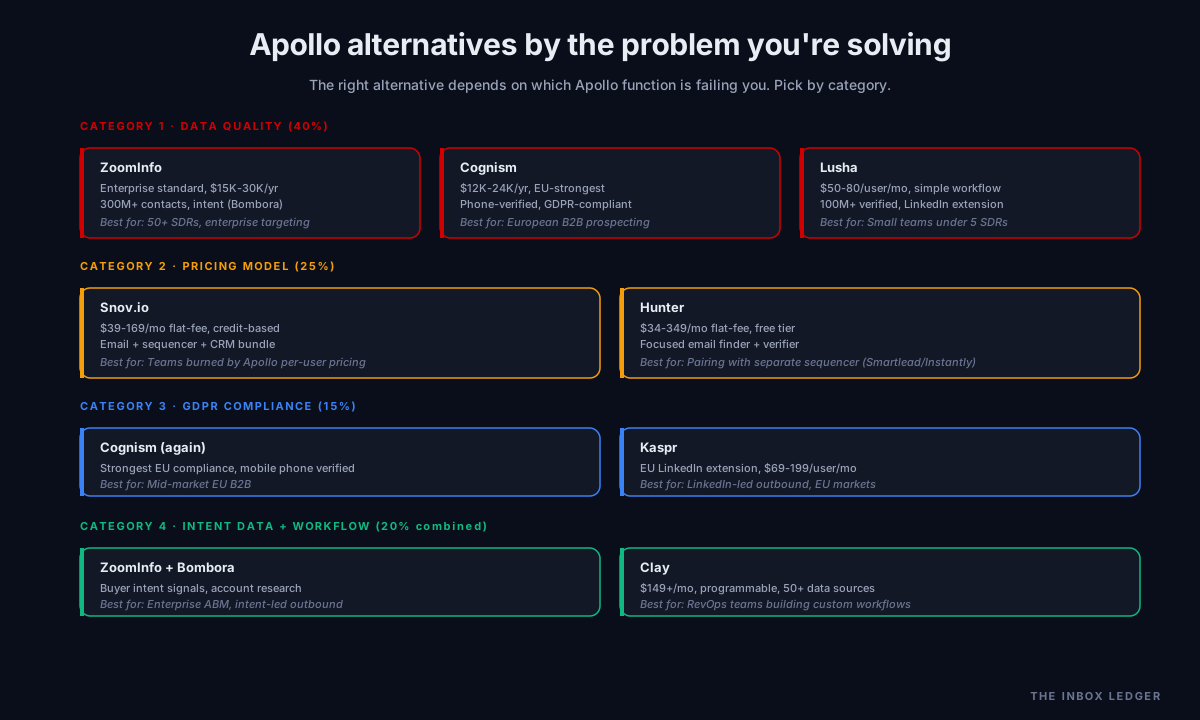
On the audits we run, teams shopping for Apollo alternatives almost always fall into one of five categories. The category determines the right replacement. Generic Apollo alternatives listicles miss this because they treat all complaints as equivalent; in practice they require fundamentally different tooling.
Data quality complaints (about 40% of teams we see leaving). Most sales intelligence platforms vary dramatically in data accuracy. Apollo’s contact database is large but machine-verified, which produces higher bounce rates than human-verified competitors. Teams running cold outbound where bounce rates above 2% damage sender reputation feel this acutely; after Google’s bulk sender enforcement made 0.3% complaint rates a hard ceiling at Gmail, contact data quality moved from nice-to-have to operational requirement. The replacement category is verified-data providers, not feature-equivalent platforms.
Pricing model complaints (about 25%). Apollo’s per-user pricing scales painfully as sales teams grow. A 20-person SDR org pays meaningfully more than a 5-person team for the same database access. Teams hitting this constraint shop for flat-fee or volume-based alternatives, not per-user platforms with different features.
GDPR and compliance complaints (about 15%). European prospecting is the use case Apollo is weakest on. Teams selling into EU markets need GDPR-compliant data sources with documented consent chains and verified phone numbers under EU privacy law (see M3AAWG’s guidance on cross-border sender compliance for the operational framework). This is a regional data provider problem, not a platform problem.
Intent data and account intelligence complaints (about 10%). Apollo provides basic firmographics. Teams that need real-time buying signals (technology stack changes, hiring patterns, funding events, website visitor identification) need a different category entirely: intent platforms, not contact databases.
Workflow and personalization complaints (about 10%). Teams that feel like “everyone on Apollo is sending the same AI-generated emails to the same contacts” need richer data context and personalization workflow, which means programmable enrichment tools rather than another all-in-one platform.
The replacement strategy follows the category. Pick the wrong category and you spend three months migrating to a tool that does not solve your actual problem.
The 8 Apollo alternatives, categorized by problem
These are the 8 lead generation tools we see actually used in production by B2B teams running outbound in 2026. Grouped by the category of complaint they solve.
For data quality complaints: ZoomInfo, Cognism, Lusha
ZoomInfo is the enterprise standard for contact data. 300M+ contacts, mature B2B intent data (Bombora integration), strong org chart mapping, and the highest data accuracy in independent G2 testing. The cost is significant: enterprise contracts typically start at $15K-30K per year. Best fit for teams above 50 SDRs where data quality directly determines pipeline output and the budget can absorb the contract minimum.
Cognism is the GDPR-compliant alternative. Strong European contact data, phone-verified mobile numbers under EU privacy regulations, sales trigger signals (job changes, funding events). Pricing is custom and typically lower than ZoomInfo for mid-market teams. Best fit for B2B teams selling into European markets where contact data needs documented consent and verified mobile numbers under GDPR.
Lusha is the lightweight verified-data option. 100M+ verified contacts, simple LinkedIn-extension workflow, no commitment to a heavy platform. Pricing starts around $50/month per user for the Pro tier. Best fit for individual SDRs and small teams (under 5) that need reliable contact lookup without learning a complex platform. All three are verified contact data providers solving different sub-versions of the data quality problem at different team scales.
For pricing model complaints: Snov.io, Hunter
Snov.io is the flat-fee alternative that competes most directly on price. Email finder, verifier, drip campaigns, and CRM all under one subscription that does not scale per-user the way Apollo does. Pricing starts around $39/month for the entry tier with 1,000 credits, scaling to $169/month for higher-volume tiers. Best fit for teams that found Apollo’s per-user pricing painful and want flat credit-based costs.
Hunter is the focused email-finder tool. Verified domain-based email lookup, simple campaigns, and a free tier that’s genuinely useful for low-volume sending. Hunter does one thing (find and verify professional emails) and does it well. Pricing starts at $34/month, scaling to $349/month. Best fit for teams that already have a sequencer (Instantly, Smartlead, or similar) and need just the email finder layer.
For GDPR and compliance complaints: Cognism (again), Kaspr
Cognism appears in this category because GDPR compliance is genuinely its strongest differentiator. The data sources, consent management, and EU phone verification are built for European prospecting in a way Apollo’s data is not.
Kaspr is the European-focused LinkedIn extension. Strong on EU contact data including verified mobile phone numbers, GDPR-compliant collection processes, and a workflow that integrates with LinkedIn Sales Navigator. Best fit for teams running LinkedIn-led outbound in European markets where mobile phone access matters.
For intent data and account intelligence: ZoomInfo, Clay
ZoomInfo with the Bombora intent integration is the enterprise standard for buyer intent signals: which accounts are actively researching your category, which competitors they’re evaluating, what topics they’re consuming. This is the use case that justifies ZoomInfo’s contract cost most clearly.
Clay is the programmable alternative. Rather than a fixed intent dataset, Clay lets you build custom enrichment workflows pulling from 50+ data sources (LinkedIn, BuiltWith, news APIs, social signals, custom scrapers) into a spreadsheet-like interface. Pricing starts around $149/month and scales with usage. Best fit for RevOps teams that want full control over the enrichment logic and have someone who can build workflows.
For workflow and personalization: Clay, custom enrichment stacks
Clay (again) leads this category because the programmable enrichment model produces deeper personalization than Apollo’s templated approach. Teams using Clay build workflows that pull a prospect’s recent LinkedIn post, their company’s recent news, their tech stack from BuiltWith, and use it all in the first line of cold outreach.
Custom enrichment stacks (using tools like Clay, Apollo’s data API, LinkedIn Sales Navigator, and a sequencer like Smartlead or Instantly) are increasingly common at teams above 20 SDRs. The stack is more complex but produces personalization quality that no single all-in-one can match.
Pricing comparison: what each alternative actually costs
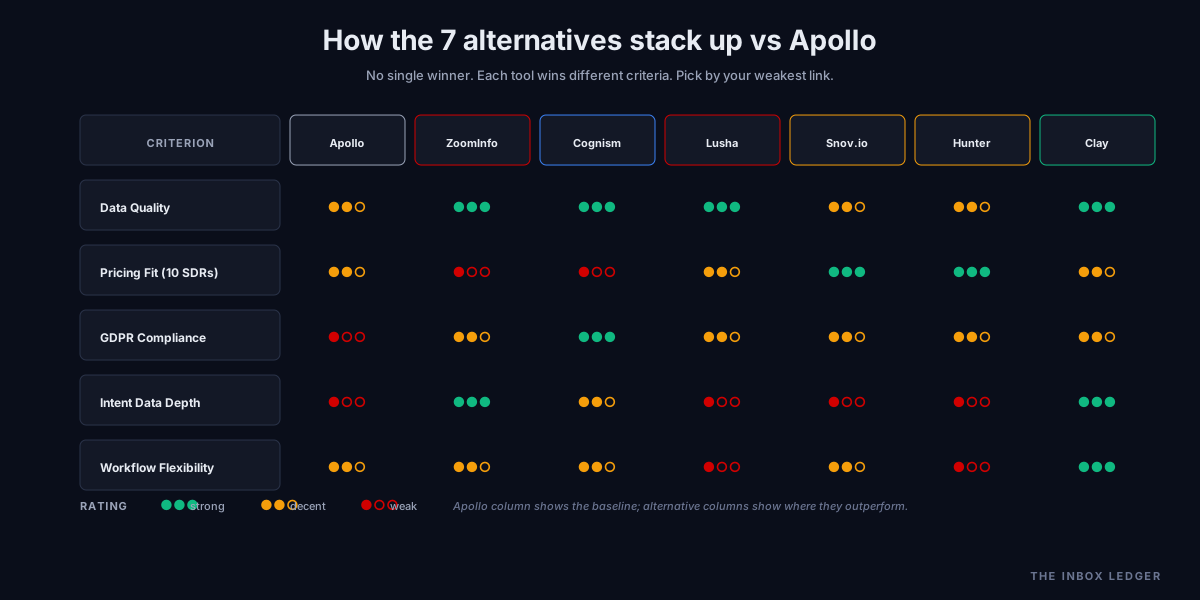
What we see most often is teams budget for the listed price and miss the total cost. Real-world pricing varies dramatically based on team size and usage:
ZoomInfo: $15,000-$30,000+ per year minimum (annual contracts only at most tiers). Per-user pricing baked into the contract structure. Total cost at 10 SDRs is typically $20K-40K per year.
Cognism: Custom pricing, generally $12,000-$24,000 per year for mid-market teams. Annual contracts. Total cost at 10 SDRs is typically $18K-30K per year.
Lusha: $50-$80 per user per month at the Pro tier, scaling to custom at the Premium tier. Total cost at 10 SDRs is typically $6K-12K per year.
Snov.io: $39-$169 per month flat-fee (team plans available). Volume-based credit system rather than per-user. Total cost at 10 SDRs is typically $2K-5K per year. The big jump compared to per-user tools.
Hunter: $34-$349 per month flat-fee. Credit-based. Total cost at 10 SDRs is typically $2K-4K per year for the relevant tier.
Kaspr: $69-$199 per user per month. Total cost at 10 SDRs is typically $8K-24K per year depending on tier.
Clay: $149-$800+ per month flat-fee (Pro to Enterprise tiers). Usage-based credits within tier. Total cost at 10 SDRs is typically $5K-15K per year, more if heavy enrichment volume.
For comparison: Apollo at the Professional tier ($79/user/month, the most common SMB tier) costs about $9.5K per year at 10 SDRs. Apollo’s pricing advantage holds at small team sizes; it inverts at scale because most Apollo alternatives use flat-fee or lower per-user costs.
The migration mistakes that derail Apollo replacements
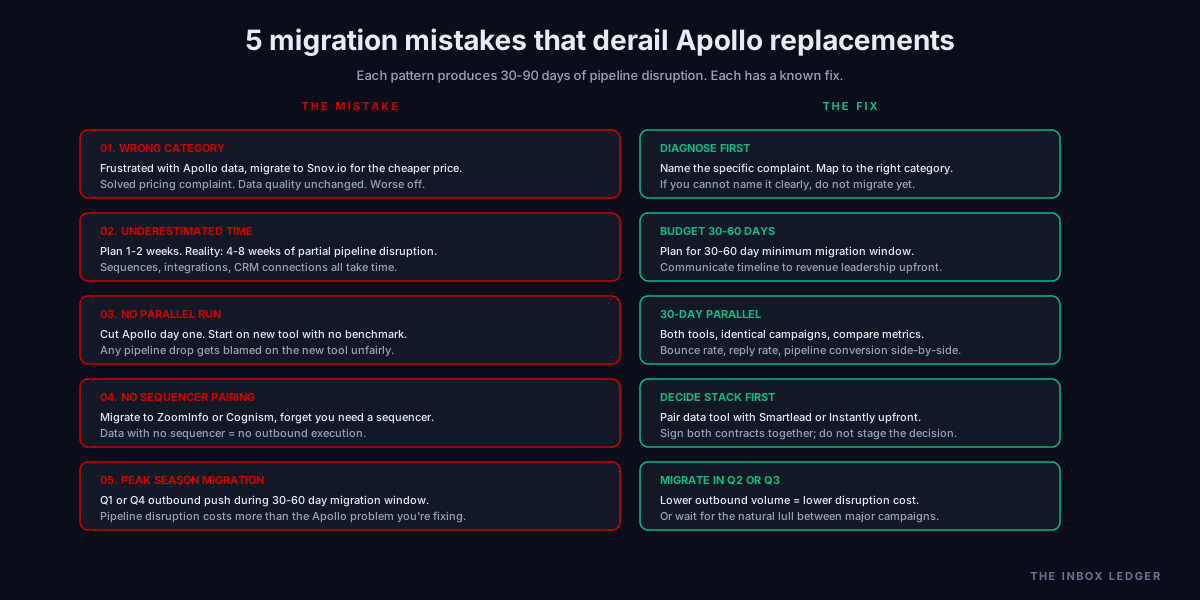
Five patterns we see most often on teams that tried and failed to replace Apollo:
1. Choosing the wrong category
The biggest mistake. A team frustrated with Apollo’s data quality migrates to Snov.io because Snov is cheaper, then finds Snov’s data is also machine-verified. The pricing problem was solved; the data quality problem was not. Pick the alternative that solves the actual problem, not the most-recommended generic alternative.
2. Underestimating migration time
Migrating an active outbound program from Apollo to another platform takes 30 to 60 days minimum. Sequences need to be rebuilt, integrations re-tested, list exports re-imported (often with field mapping issues), CRM connections re-established. Most teams budget 1-2 weeks; the real cost is 4-8 weeks of partial pipeline disruption.
3. Skipping the parallel-run period
The teams we work with that migrate successfully run both Apollo and the new tool in parallel for 30 days. Compare bounce rates, reply rates, and pipeline conversion on identical campaigns. The team that just cuts Apollo on day one and starts on the new tool has no benchmark; they assume any pipeline drop is the new tool’s fault when it might be sales reps adjusting to the new workflow.
4. Not pairing data with a dedicated sequencer
The Apollo all-in-one bundles data and sequencing. If you migrate to a data-only tool like ZoomInfo or Cognism, you also need a sequencer. The natural pairings are ZoomInfo or Cognism plus Smartlead or Instantly for outbound execution. See instantly vs smartlead for the sequencer decision.
5. Migrating during peak campaign season
If your team runs Q1 and Q4 hard for outbound, do not migrate during those quarters. The pipeline disruption from a 30-60 day migration during peak season costs more than waiting. Migrate in Q2 or Q3 when outbound volume is naturally lower.
The practical decision framework
The decision tree we use when teams ask whether to leave Apollo, and which Apollo alternatives to evaluate:
- Identify the primary complaint. Data quality, pricing, GDPR, intent data, or workflow. If you cannot name one clearly, do not migrate yet; spend two more weeks documenting which specific Apollo behavior is failing
- Map complaint to category. Data quality leads to ZoomInfo, Cognism, or Lusha. Pricing leads to Snov.io or Hunter. GDPR leads to Cognism or Kaspr. Intent data leads to ZoomInfo or Clay. Workflow leads to Clay
- Verify the tool’s strength matches. Schedule a demo. Get sample data for your specific ICPs. Run your own bounce rate test on 100 contacts before committing
- Plan the parallel run. 30 days minimum running both tools, identical campaigns, comparing on bounce rate, reply rate, and pipeline conversion
- Confirm sequencer pairing. If migrating to a data-only tool, decide on the sequencer (Smartlead, Instantly, or similar) before signing the data contract
- Pick the migration window. Q2 or Q3 ideally, not Q1 or Q4 unless the Apollo problem is actively hurting current pipeline
- Build the rollback plan. Keep Apollo active for 60 days after migration. If the new tool underperforms, you have a fast path back. The 60-day overlap cost is real but worth it
- Document the decision. Six months from now, when someone asks “why did we leave Apollo,” the answer should be a specific complaint and the data that justified the move
When Apollo is still the right choice
The teams we work with that stay on Apollo tend to share three characteristics. If these match your situation, leaving Apollo may not solve your real problem:
You’re under 5 SDRs. Apollo’s pricing advantage is real at small team sizes. The complexity tax of running a multi-tool stack (data + sequencer + enrichment) outweighs the data quality or feature gap for small teams. Stay on Apollo until you hit 8-10 SDRs.
You’re in early-stage outbound. Teams still finding product-market fit benefit from Apollo’s all-in-one workflow because they’re still figuring out which signals matter, what messaging works, which ICPs to target. The flexibility to test broadly with one tool matters more than the depth of any specific feature. Migrate after you have a working playbook.
You don’t have RevOps capacity. Running ZoomInfo + Smartlead + Clay requires someone who maintains the stack. Teams without RevOps headcount or a willing SDR-with-tech-skills end up with broken pipelines, unmapped CRM fields, and failed integrations. Apollo’s bundling avoids this. Migrate when you have someone to own the stack.
The point is not that Apollo is bad and the Apollo alternatives are good. The point is that Apollo is good at being an all-in-one for teams in a specific stage, and the question of when to leave depends on your stage, not on whether you’re “supposed to” upgrade.
How Apollo alternatives connect to your broader outbound stack
Choosing the right Apollo alternatives is one decision in a stack of five that determines whether your outbound program produces pipeline:
- Data source (Apollo, ZoomInfo, Cognism, Lusha, Clay, etc.)
- List verification (EmailListVerify, ZeroBounce, NeverBounce) for email hygiene
- Sending infrastructure (Smartlead, Instantly, lemlist) covered in best cold email software
- Authentication (SPF DKIM DMARC setup, DMARC policy)
- Warmup (email warmup tools)
The data source decision is upstream of everything. Bad data means high bounce rates, which damages sender reputation (verifiable via Google Postmaster Tools and Microsoft SNDS), which collapses email deliverability, which means even great sequences land in spam. Teams that obsess over Apollo alternatives without fixing the infrastructure underneath end up with the same outbound problems on a different platform.
For the operational sequence that turns good data into booked meetings, see the cold email outreach guide, the cold email follow-up guide, and the cold email templates guide. For the broader cold email infrastructure context, see the cold email deliverability checklist.
Frequently asked questions
What are the best Apollo alternatives for B2B teams in 2026?
What's the cheapest alternative to Apollo?
Is ZoomInfo worth the cost compared to Apollo?
Which Apollo alternative is best for GDPR compliance?
How long does it take to migrate from Apollo to another tool?
Should I use Apollo and another tool together?
What's the difference between Apollo and Clay?
The bottom line on Apollo alternatives
Choosing the right Apollo alternatives is not a feature comparison exercise. It is a diagnosis exercise. The teams we work with that migrate successfully start by naming the specific Apollo alternatives complaint, map it to the right category of replacement, and pick the alternative that genuinely solves that problem rather than the one that ranks highest in generic comparison lists. The teams that migrate poorly treat all Apollo alternatives as equivalent feature-checkers and end up with the same operational problem on a different platform 12 months later.
The other discipline that matters: Apollo is not always the problem. On about a third of the outbound audits we run, the team blaming Apollo actually has a sender reputation problem, a list hygiene gap, or an authentication misconfiguration that no data tool change will fix. Migrating to a better tool with worse operational discipline produces the same outcomes on a new platform.
For the operational baseline that makes any data tool produce results, see the cold email deliverability checklist and the email deliverability pillar. For the cold email infrastructure that pairs with your data tool, see the best cold email software and the cold email outreach guide.
Subscribe to the weekly briefing for operator-grade outbound and prospecting notes, one short email every week.
More on Comparisons
Lemlist alternatives 2026: 8 tools by why you're leaving
Lemlist alternatives in 2026 grouped by why you are switching: per-seat pricing, cold email deliverability, multichannel needs, or simplicity.
Instantly vs Smartlead in 2026: which one fits your stack
Instantly vs Smartlead for 2026: pricing, deliverability, warmup, agency features, and which platform fits solo operators vs cold email agencies.