Email enrichment 2026: 8 tools by what you're enriching
Email enrichment in 2026: waterfall vs single-source, the 8 tools by job, the data decay reality, and the verification step vendor benchmarks obscure.
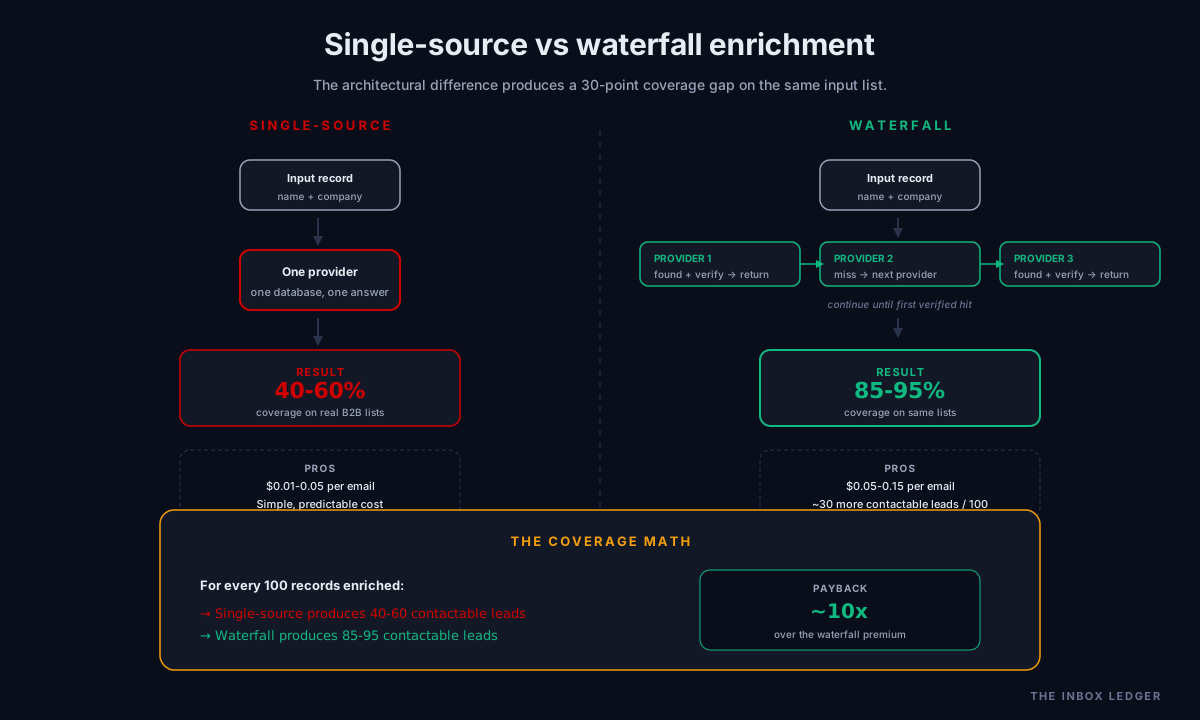
Email enrichment in 2026 has split into a category where the architectural choice matters more than the brand name on the marketing page. Single-source enrichment, where one provider returns one answer from one database, caps at roughly 40 to 60 percent coverage on a real B2B list. Waterfall enrichment, where multiple providers are queried in sequence until a verified result returns, lifts that to 85 to 95 percent in tested benchmarks. The 30-point gap between single-source and waterfall data enrichment is not a small optimization; it is the difference between a serious outbound program and one that runs out of contactable leads halfway through every campaign. The vendors that still operate as single-source databases are quietly losing share to waterfall tools and programmable platforms, and the published accuracy numbers across the category are misleading enough that picking by them is the most common email enrichment mistake we see.
This guide is the decision framework we use when teams ask which email enrichment tools to evaluate. It covers what enrichment actually is in 2026, the five distinct jobs teams hire enrichment for, the eight tools that solve those jobs with honest tradeoffs, the waterfall versus single-source choice, the data decay reality that determines refresh cadence, and the verification step that turns a finder result into a sendable email. Written for RevOps, SDRs, and founders who need their enriched data to actually convert rather than to look good in a vendor’s benchmark.
For the broader prospecting context, see the email finder tools guide and the Apollo alternatives guide for the data layer. For the deliverability foundation that determines whether enriched contacts actually reach inboxes, see the email deliverability pillar and the email hygiene guide.
What email enrichment actually is in 2026
Email enrichment, the broader category of b2b data enrichment, is the process of taking a partial record (a name, a domain, a LinkedIn URL, sometimes just a company) and completing it with verified contact details: business email, mobile phone, job title, firmographics, technographics, and sometimes intent signals. The category split in 2026 produces three distinct architectural approaches that produce different results on the same input list.
Single-source enrichment. One provider, one database, one answer. The classic model used by Apollo, Hunter, Lusha, RocketReach, and most of the established players. Simple, fast, predictable cost, and capped at the coverage of one provider’s database. On standard B2B lists this lands at 40 to 60 percent coverage; on harder lists (EU mid-market, technical roles, senior leadership) it drops further.
Waterfall enrichment. Multiple providers queried in sequence until a verified result returns. FullEnrich, BetterContact, SyncGTM, and Cleanlist are the dedicated players; Clay covers the same use case as a programmable platform. Coverage lifts to 85 to 95 percent on the same lists because where provider 1 returns nothing, provider 2 might have the contact, and provider 3 might have a fresher version.
Programmable enrichment. A workflow platform (Clay primarily, plus self-hosted n8n setups) that lets you build your own waterfall logic combining 50+ data sources with custom rules. Most flexible, also most operationally complex; requires someone who can build and maintain the workflow.
The architectural choice matters more than which specific provider you pick within an architecture. A team running waterfall enrichment on three average providers will out-perform a team running single-source on the best individual provider. The 2026 question is not “which database has the best data” but “which architecture matches my coverage needs and operational capacity.”
The five jobs teams hire email enrichment for
Most articles on this topic miss the job-to-be-done split. The right email enrichment tool depends on which of these five jobs is your primary use case, and the recommendations differ meaningfully across them.
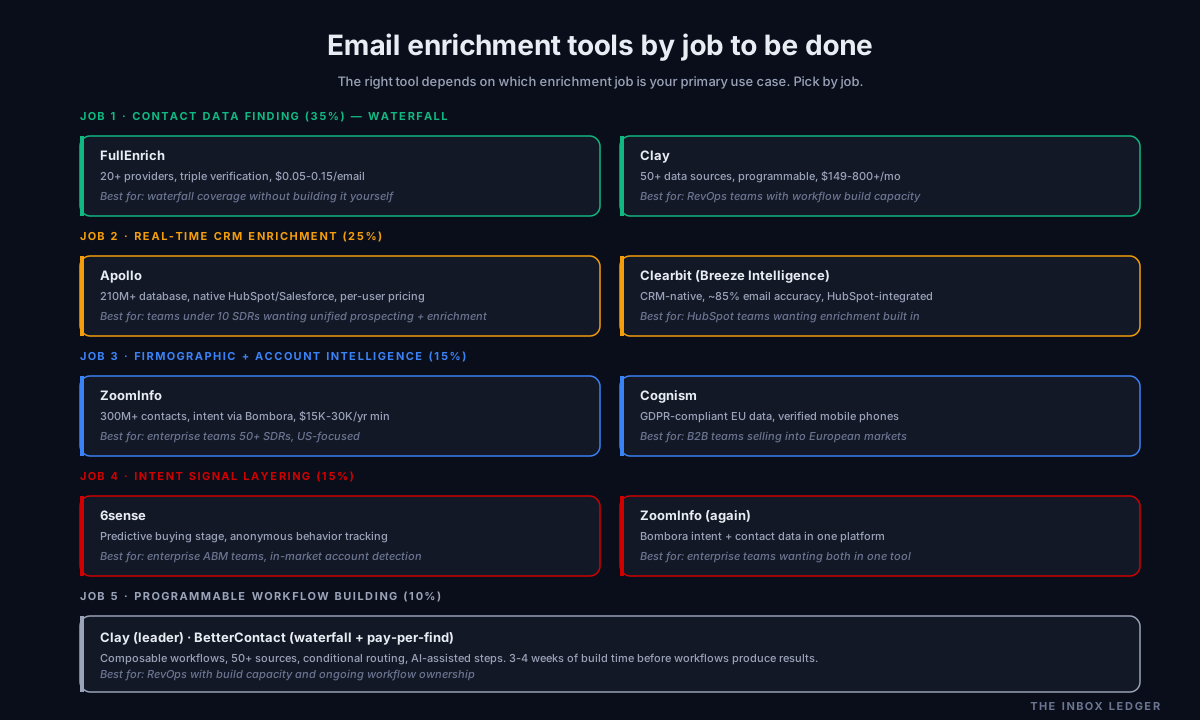
Contact data finding (about 35% of teams we see). Contact enrichment in its purest form: starting from a list of names and companies (or LinkedIn URLs) and adding verified business emails and mobile phones. The classic prospecting use case, where waterfall coverage is the dominant variable.
Real-time CRM enrichment (about 25%). Enriching new records the moment they enter the CRM, so every lead arrives with firmographics, contact details, and routing data already attached. The job is API latency and CRM integration depth, not raw database breadth.
Firmographic and account intelligence (about 15%). Enriching at the account level with company size, revenue, industry, technographics, and account hierarchies. Different vendors win this than win contact-finding; ZoomInfo and Cognism dominate.
Intent signal layering (about 15%). Adding buying-stage signals on top of contact data: who is researching your category, which competitors they are evaluating, what topics they are consuming. Bombora integration via ZoomInfo is the enterprise standard; 6sense is the dedicated player.
Programmable workflow building (about 10%). Building custom enrichment logic combining multiple data sources, conditional routing, and AI-assisted steps. Clay is the leader; self-hosted n8n is the cheaper-at-volume alternative.
The picks for each job are different, the cost structures are different, and getting the job wrong is the most common reason teams pay for enrichment tools they barely use. Pick by the job, not by the vendor everyone else picked.
The 8 email enrichment tools, categorized by job
These are the 8 enrichment tools we see actually used in production by B2B teams in 2026. Grouped by the job they best solve.
For contact data finding with maximum coverage: FullEnrich, Clay
FullEnrich is the purpose-built waterfall tool. Queries 20+ providers (Apollo, Hunter, Dropcontact, Kaspr, RocketReach, others) in sequence and returns the first verified result. Triple-pass email verification keeps bounce rates under 1 percent. Credits charge only on successful enrichment, not on misses. Pricing roughly $0.05 to $0.15 per verified email depending on waterfall depth. Best fit for teams that want waterfall coverage without building it themselves and where coverage matters more than per-email cost.
Clay is the programmable alternative for contact data finding. Rather than a fixed waterfall, Clay lets you compose 50+ data sources into your own logic with conditional routing and AI-assisted steps. Pricing moved to Launch, Growth, and Enterprise tiers in March 2026 with separate Data Credits and Actions billing. Best fit for RevOps teams with build capacity who want maximum flexibility and can support the workflow.
For real-time CRM enrichment: Apollo, Clearbit
Apollo does real-time CRM enrichment well at common team sizes through its native HubSpot and Salesforce integrations. Records get enriched on entry with firmographics, contact details, and the Apollo database’s coverage. Per-user pricing scales painfully past 10 SDRs (the Apollo alternatives guide covers the typical migration path), but for teams under that ceiling, the integration depth and unified prospecting plus enrichment story is hard to beat.
Clearbit (now part of HubSpot as Breeze Intelligence) is the long-running CRM-native data layer. Real-time enrichment of leads as they enter the CRM, with firmographic and contact data alongside the deeper HubSpot platform. Best fit for teams already on HubSpot who want enrichment integrated rather than bolted on. Independent benchmarks put Clearbit around 85 percent email accuracy.
For firmographic and account intelligence: ZoomInfo, Cognism
ZoomInfo holds the largest proprietary B2B database in the category (300M+ contacts) with built-in intent data via the Bombora partnership. Strong enterprise targeting, org chart mapping, and the highest accuracy on independent benchmarks for US enterprise contacts. Pricing starts at $15K to $30K per year minimum, with annual contracts only at most tiers. Best fit for enterprise teams above 50 SDRs where data quality determines pipeline output.
Cognism is the GDPR-compliant alternative for European prospecting. Strong EU contact data, phone-verified mobile numbers under EU privacy regulations, sales trigger signals. Pricing typically $12K to $24K per year for mid-market teams. Best fit for B2B teams selling into European markets where GDPR compliance and verified EU mobile data are operationally required.
For intent signal layering: 6sense, ZoomInfo
6sense is the dedicated intent intelligence platform. AI-powered account scoring, predictive buying stage signals, firmographic and technographic data, and anonymous buyer behavior tracking across the web. Best fit for enterprise account-based teams where knowing which accounts are in-market matters more than raw contact volume.
ZoomInfo appears here again because Bombora integration makes it the enterprise standard for intent at scale. Teams that need both contact data and intent at enterprise volume often land on ZoomInfo rather than running 6sense plus a separate contact provider.
For programmable workflow building: Clay, BetterContact
Clay is the leader by a wide margin. 50+ data sources composable into custom workflows, conditional routing, AI-assisted steps, integrations with virtually every tool in the GTM stack. The price of flexibility is operational complexity; expect 3 to 4 weeks of build time before workflows produce results.
BetterContact is the AI-powered waterfall with 20+ providers including Apollo, RocketReach, and ContactOut, charging credits only on successful finds. Pay-per-find pricing makes cost predictable, and average enrichment rates of 87 to 95 percent put it in the top tier of coverage. Best fit for teams that want waterfall coverage with a credit model rather than a flat-fee platform.
Single-source versus waterfall: the math that decides
The waterfall versus single-source choice is the most consequential email enrichment decision in 2026, and the math is decisive enough that most teams should default to waterfall unless a specific constraint pushes the other direction.
Single-source coverage. Independent tested benchmarks put single-source providers at 40 to 60 percent coverage on standard B2B lists. The number drops on harder lists: technical roles, EU mid-market, senior leadership.
Waterfall coverage. The same lists with a 3-step waterfall hit 85 to 95 percent in tested benchmarks. A Cleanlist 1,000-record test measured 62 percent from the best single source against 92 to 98 percent stacked. A SyncGTM 500-account test measured 78 percent from the best single source against 92 percent waterfall.
The pipeline math. For every 100 records enriched, a single-source program produces 40 to 60 contactable leads; a waterfall program produces 85 to 95. At common SDR pipeline economics where each contactable lead has a measurable conversion value, the 30-to-45-lead gap pays back the waterfall premium roughly 10x over.
The cost premium. Waterfall is more expensive per verified email ($0.05 to $0.15 for waterfall versus $0.01 to $0.05 for single-source), but the cost per verified email captures only one dimension. The right comparison is cost per usable contactable lead, where waterfall typically wins because the coverage difference compounds.
When single-source still wins. Very small lists (under 100 contacts per month) where the operational overhead of waterfall is not justified. Specific geographies where one provider has dominant data (Cognism for EU, Lusha for certain Asian markets). Teams without RevOps capacity to manage credit allocation across multiple providers.
For most B2B outbound teams in 2026, waterfall is the right default and single-source is the exception. The opposite framing was true in 2022; it is no longer.
The data decay reality that determines refresh cadence
B2B contact data decays at roughly 2.1 percent per month, which compounds to about 25 percent per year. People change jobs, titles shift, companies rebrand, domains migrate, mailboxes get retired. The wrong rows are usually the most active ones: senior buyers move, junior contributors stay.
The practical implication for email enrichment workflow: a database enriched clean in January is roughly one quarter wrong by December, and the wrong contacts are usually the most senior ones you most wanted to reach. Teams that treat enrichment as a one-time list-building activity end up sending to retired mailboxes and damaging sender reputation through bounce spikes.
The refresh cadence that works:
- Hot contacts (active outbound targets): re-enrich every 30 days to catch job changes and title shifts before campaigns run
- Warm contacts (recent prospects): re-enrich quarterly to maintain accuracy without burning credits
- Cold contacts (long-tail database): re-enrich every 6 months or before the next campaign that touches them, whichever comes first
- Trigger-based refresh: integrate with job change signals (LinkedIn alerts, Champion/Buyer change tools) to refresh individual records when public signals indicate movement
For teams with significant CRM volumes, the practical pattern is a small daily enrichment job for new and recently-modified records, plus a larger weekly batch for older records that have not been touched. The cost of running this is real but smaller than the cost of sending campaigns to addresses that no longer work.
The verification step that vendor benchmarks obscure
Every email enrichment vendor publishes accuracy numbers; the numbers are usually misleading. The pattern from articles 19 and 24 holds here: Saleshandy’s benchmark ranks Saleshandy first, Amplemarket’s scoring framework puts Amplemarket at 219/231, FullEnrich’s claims FullEnrich at 1 percent bounce rate. Each vendor’s published number reflects their own panel under their own methodology.
The single most important reality the marketing pages obscure: an enrichment result is not a verification. Most enrichment providers tag results as “verified,” but the verification methods differ. Some check syntax. Some hit the mail server. Some cross-reference multiple sources. The same email tagged “verified” by three different providers may have bounce rates ranging from 0.5 percent to 5 percent depending on what verification actually meant.
The fix is a separate verification step on every list before any send, regardless of the enrichment provider’s confidence tag:
- Run the enriched list through an independent verifier: EmailListVerify, ZeroBounce, NeverBounce, or Bouncer
- Drop anything tagged risky, catchall, or unknown even if the enrichment provider tagged it verified
- Keep the bounce rate target under 2 percent, with top-performing programs targeting hard bounces under 1 percent (in line with Google’s bulk sender requirements and Microsoft’s high-volume sender enforcement)
- Build the verification step into the enrichment workflow, not as a one-time check before the first campaign
For the broader hygiene discipline, see the email hygiene guide. The discipline that separates programs that consistently land in inboxes from programs that constantly fight bounce-rate fires is treating verification as a step in the enrichment pipeline, not an optional post-processing check.
Common email enrichment mistakes
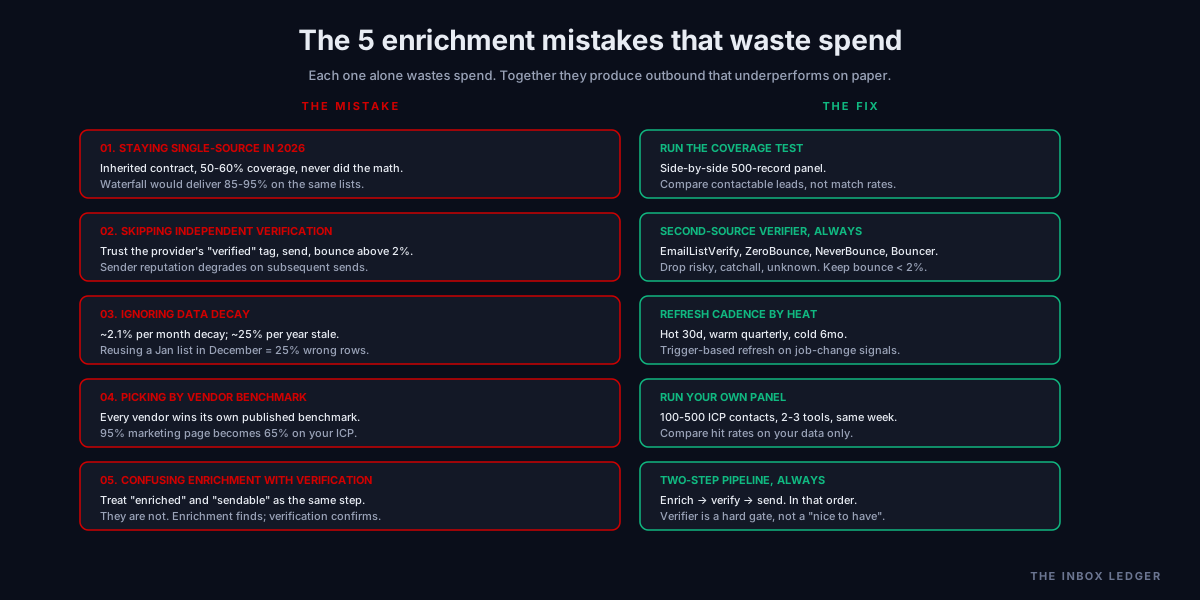
Five patterns we see most often on audits:
1. Staying single-source when waterfall has won
The most expensive mistake in 2026. Teams inherited a single-source contract, never did the coverage math, and continue running at 50 to 60 percent enrichment when 85 to 95 is available. The fix is running a side-by-side test of single-source versus waterfall on the same 500-record panel and comparing contactable leads produced, not just match rates.
2. Skipping the independent verification step
Trusting the enrichment provider’s “verified” tag without running a separate verifier. Bounce rates climb above 2 percent and sender reputation degrades, visible in Google Postmaster Tools within days. The fix is treating verification as a workflow step on every list, regardless of how confident the enrichment provider claims to be.
3. Ignoring data decay
Treating an enriched database as static and reusing it for campaigns 6 to 12 months later. Roughly 25 percent of the most senior contacts have moved. The fix is the refresh cadence above: 30 days for hot, quarterly for warm, 6 months for cold, plus trigger-based refresh on job change signals.
4. Picking by vendor benchmark
The same vendor-benchmark trap we covered in email finder tools and Apollo alternatives. Every vendor wins its own test. The fix is a 100 to 500 contact test panel on your actual ICP, submitted to 2 to 3 candidates the same week, with deliverability verified by a second-source verifier.
5. Confusing enrichment with verification
Treating “enriched” and “verified for sending” as the same thing. They are not. Enrichment returns a likely email; verification confirms it will not bounce. Running a great enrichment provider into a campaign without independent verification produces bounces from contacts the enrichment marked confident. The fix is the two-step pipeline: enrichment then verification, always in that order, with the verifier as a hard gate before sending.
The practical email enrichment decision framework
The decision process we use when teams ask which enrichment tool to evaluate:
- Name the primary job. Contact data finding, real-time CRM enrichment, firmographic and account intelligence, intent signal layering, or programmable workflow building. If you cannot name one clearly, document your actual workflow for a week before deciding
- Default to waterfall for contact data finding. Single-source is the exception in 2026, not the rule. The coverage math is decisive enough that the default flips for most B2B outbound use cases
- Map the job to the right architecture. Waterfall (FullEnrich, BetterContact, Clay) for contact finding. CRM-native (Apollo, Clearbit/Breeze) for real-time enrichment. Enterprise database (ZoomInfo, Cognism) for firmographic and account intelligence. Programmable (Clay, n8n) for custom workflows
- Run your own test panel. 100 to 500 contacts on your real ICP, submitted to 2 to 3 candidates the same week, hit rates compared on your data
- Verify with a second source. Every enriched list runs through EmailListVerify, ZeroBounce, NeverBounce, or Bouncer before any send. Drop risky, catchall, and unknown
- Compare cost per contactable lead, not cost per credit. A tool at half the per-credit price with half the coverage costs the same per contactable lead and produces fewer of them
- Start monthly, commit annually only after 30 days of real data. Avoid annual commitment on the demo. Treat the first month as evaluation, not production
- Build refresh cadence into the workflow from day one. 30 days for hot, quarterly for warm, 6 months for cold. Enrichment is a flow, not a one-time stock
The discipline that matters most: a great enrichment provider does not save a workflow with no verification and no refresh cadence. The tool sits inside a system, and the system has to be designed around data decay and bounce-rate discipline rather than pretending neither exists.
How email enrichment fits in 2026’s broader outbound stack
Email enrichment is one decision in a stack that determines outbound outcomes:
- Data sourcing (the email finder tools guide for individual lookup, this article for enrichment at volume, and the Apollo alternatives guide for the broader provider landscape)
- List verification (the email hygiene guide covers the verification discipline)
- Sending infrastructure (the cold email infrastructure guide covers the five-layer build, the best cold email software guide covers the platforms, and the instantly vs smartlead comparison covers the two most common picks)
- Authentication (the SPF DKIM DMARC setup guide and DMARC policy guide)
- Reputation and warmup (the sender reputation guide and email warmup tools guide)
- Sequencing and messaging (the cold email outreach guide, cold email templates guide, and cold email follow-up guide)
The enrichment layer is upstream of everything else. Bad enrichment through a great sending stack still produces bounces and damages reputation; good enrichment through a mediocre sending stack at least reaches some inboxes. But neither produces results without the broader system, which is why teams obsessing over enrichment tool choice while ignoring infrastructure end up with the same outbound outcomes regardless of which enrichment provider they paid for.
For the operational baseline that turns enriched contacts into booked meetings, see the cold email deliverability checklist and the how to improve email deliverability walkthrough. For when team size outgrows what any one enrichment provider can serve, the Lemlist alternatives guide and cold email agency guide cover the build-versus-outsource decision.
Frequently asked questions
What is email enrichment and how does it work?
What is the best email enrichment tool in 2026?
What is waterfall enrichment and is it worth the cost?
How accurate is email enrichment data?
How often does B2B contact data decay?
Do I need to verify enriched emails separately?
What is the difference between email enrichment and email verification?
The bottom line on email enrichment
The 2026 email enrichment decision is architectural before it is brand-level. Email enrichment in this era is no longer about which database is largest. Waterfall enrichment has won the coverage argument decisively, and single-source remains the right choice only in narrow scenarios. The teams we work with that get enrichment right pick the architecture that matches the job (waterfall for contact finding, CRM-native for real-time, enterprise database for firmographic and intent), run their own test panel before committing, verify every enriched list through an independent verifier before sending, and build refresh cadence into the workflow rather than treating data as a static stock.
The teams that get it wrong stay single-source out of inertia, trust the enrichment provider’s verified tag without independent verification, treat enrichment as a one-time activity, and pick by vendor-published benchmarks that are designed to flatter the vendor. Each of these individually wastes spend; together they produce outbound programs that consistently underperform their stack on paper. The discipline that separates programs that work is treating enrichment as a continuous system with three steps (enrich, verify, refresh) rather than a one-time list build.
For the broader prospecting context, see the email finder tools guide and the Apollo alternatives guide. For the operational stack that turns enriched data into pipeline, see the cold email infrastructure guide and the cold email deliverability checklist.
Subscribe to the weekly briefing for operator-grade enrichment and outbound notes, one short email every week.
More on Outbound Sales
B2B lead generation tools 2026: 10 picks by funnel stage
B2B lead generation tools in 2026 mapped to the funnel stage they actually solve: visitor capture, prospecting, enrichment, activation, and routing.
Email finder tools 2026: 8 picks by job to be done
Email finder tools in 2026 categorized by job: single lookups, bulk prospecting, coverage maximization, CRM enrichment, or sequencing-included workflow.